Project-Based Assessment in Biology Learning: Enhancing Student Collaboration and Creativity
Keywords:
Project-based assessment; Biology learning; Collaboration skills; Student creativity; Junior high schoolAbstract
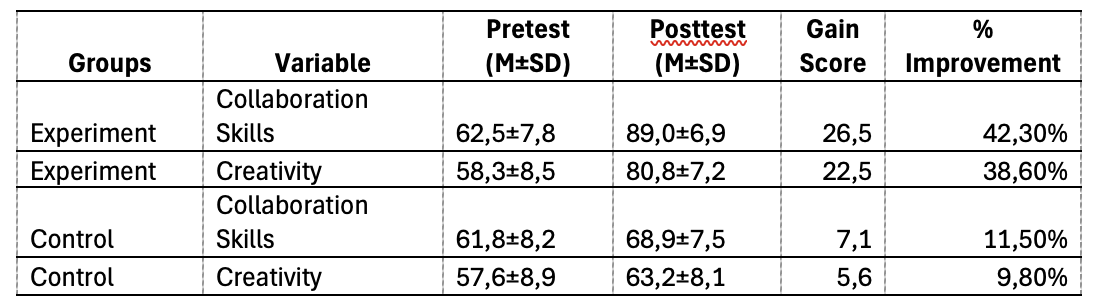
This study aims to analyze the effectiveness of project-based assessment in biology learning to enhance collaboration and creativity of junior high school students. The research method used is a quasi-experimental design with a pretest-posttest control group approach involving 64 eighth-grade students at SMP Negeri 1 Maros divided into experimental and control groups. Data collection techniques include questionnaires, observation, and assessment rubrics. Data analysis was performed using paired t-test and independent t-test. The results showed that the application of project-based assessment significantly increased students' collaboration and creativity compared to conventional assessment methods. The experimental group showed an increase in collaboration skills of 42.3% and creativity of 38.6%, while the control group only increased by 11.5% and 9.8% respectively. This innovation offers an effective alternative in making biology learning more meaningful and developing 21st-century skills for junior high school students.
References
Abas, A., et al. (2024). Integration of project-based learning to improve students’ scientific process skills and concept understanding on the material of invertebrate zoology. Jurnal Pendidikan: Teori, Penelitian, dan Pengembangan di Bidang Biologi, 9(7), 919–930. https://doi.org/10.17977/um052v9i7p919-930
Abas, A., et al. (2024). Integration of project-based learning to improve students’ scientific process skills and concept understanding on the material of invertebrate zoology. Jurnal Pendidikan: Teori, Penelitian, dan Pengembangan di Bidang Biologi, 9(7), 919–930. https://doi.org/10.17977/um052v9i7p919-930
Anderson, L. W., & Krathwohl, D. R. (2021). A taxonomy for learning, teaching, and assessing: A revision of Bloom's taxonomy of educational objectives. Pearson Education.
Arga, A., & Fitri, R. (2025). Peningkatan Kemampuan Motorik Kasar Melalui Permainan Interaktif Di TK Thalabul Ilmi. SPORTIVE: Journal Of Physical Education, Sport and Recreation, 9(6), 273–283.
Buck Institute for Education. (2023). Project based learning for the 21st century: Skills for the future. BIE Publications.
Dewi, M. R., et al. (2024). Analysis of 21st century skills in the implementation of Project Based Learning in Biology Learning Merdeka Curriculum. Jurnal Pendidikan IPA Indonesia, 13(2), 1–12. https://doi.org/10.23887/jpii-undiksha.v13i2.5941
Dewi, M. R., et al. (2024). Analysis of 21st century skills in the implementation of Project Based Learning in Biology Learning Merdeka Curriculum. Jurnal Pendidikan IPA Indonesia, 13(2), 1–12. https://doi.org/10.23887/jpii-undiksha.v13i2.5941
Greenstein, L. (2022). Assessing 21st century skills: A guide to evaluating mastery and authentic learning.Corwin Press.
Guilford, J. P. (2021). Creativity: Its measurement and development. McGraw-Hill.
Guo, P., Saab, N., Post, L. S., & Admiraal, W. (2020). A review of project-based learning in higher education: Student outcomes and measures. International Journal of Educational Research, 102, 101542. https://doi.org/10.1016/j.ijer.2020.101542
Guo, P., Saab, N., Post, L. S., & Admiraal, W. (2020). A review of project-based learning in higher education: Student outcomes and measures. International Journal of Educational Research, 102, 101542. https://doi.org/10.1016/j.ijer.2020.101542
Hizqiyah, I. Y. N., et al. (2023). The project-based learning model and its contribution to developing life skills in biology education: A systematic literature review. Jurnal Pendidikan Biologi Indonesia, 9(1), 29–42. https://doi.org/10.22219/jpbi.v9i1.22089
Hizqiyah, I. Y. N., et al. (2023). The project-based learning model and its contribution to developing life skills in biology education: A systematic literature review. Jurnal Pendidikan Biologi Indonesia, 9(1), 29–42. https://doi.org/10.22219/jpbi.v9i1.22089
Johnson, D. W., & Johnson, R. T. (2023). Cooperative learning in the classroom.Association for Supervision and Curriculum Development.
Kagan, S., & Kagan, M. (2022). Cooperative learning structures for success.Kagan Publishing.
Komalasari, R. N. A., et al. (2024). The impact of Problem-Oriented Project Based Learning on students’ creativity in biology learning. Jurnal Pendidikan Biologi Indonesia, 10(2), 239–251. https://doi.org/10.22219/jpbi.v10i2.32497
Komalasari, R. N. A., et al. (2024). The impact of Problem-Oriented Project Based Learning on students’ creativity in biology learning. Jurnal Pendidikan Biologi Indonesia, 10(2), 239–251. https://doi.org/10.22219/jpbi.v10i2.32497
Krajcik, J. S., & Blumenfeld, P. C. (2024). Project-based learning in science education: Building authentic connections to the real world. International Journal of Science Education, 42(8), 1217-1238.
Larmer, J., Mergendoller, J., & Boss, S. (2023). Setting the standard for project based learning. ASCD.
Munandar, U. (2022). Pengembangan kreativitas anak berbakat.Rineka Cipta.
Partnership for 21st Century Learning. (2023). Framework for 21st century learning definitions. P21 Publications.
Putra, A. D., & Sari, M. K. (2024). Penerapan pembelajaran berbasis proyek dalam meningkatkan keterampilan
Rerung, C. T., Aulria, S. N. M., Arga, A., Rahmi, R., Suwardi, S., Hudain, M. A., & Mappaompo, M. A. (2025). Pelatihan Teknik Dasar Taekwondo untuk Meningkatkan Motorik dan Percaya Diri Siswa SDN Inpres 127 Moncongloe. Jurnal Perjuangan dan Pengabdian Masyarakat: JPPM, 1(1), 35-42.