Obstacles to the Quality of Education According to the Credit Hour System at the College of Physical Education and Sports Sciences University of Samarra
Keywords:
Obstacles to Quality of Education, Credit Hour System.Abstract
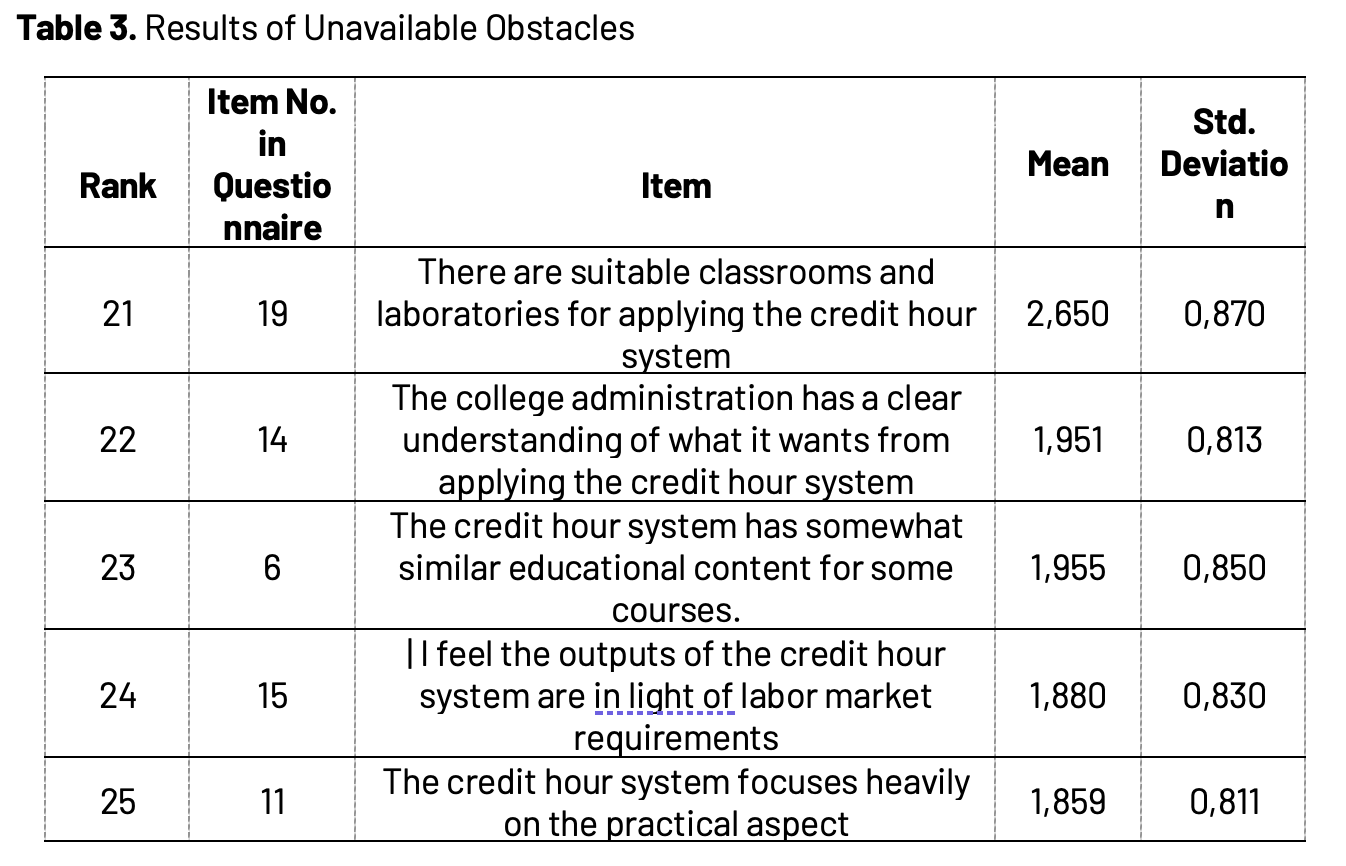
Research Objectives: To construct a questionnaire on the obstacles to the quality of education according to the credit hour system from the faculty members' perspective. To identify the obstacles to the quality of education according to the credit hour system. The researchers used the descriptive methodology with a survey method due to its suitability for the nature of the research. The research population and sample were selected from the faculty members of the College of Physical Education and Sports Sciences / University of Samarra, numbering (33). The researchers employed several statistical tools to reach results that achieve the research objectives. The researchers concluded that obstacles to the quality of education according to the credit hour system exist. The item "(Compulsory courses are proportional to the objectives of the educational process)" was identified as the highest-ranking obstacle. The researchers also put forth several recommendations, including the need for continuous attention to developing and improving the quality of education under the credit hour system.
References
Adelman, C. (2009). The Bologna Process for U.S. Eyes: Re-learning Higher Education in the Age of Convergence. Washington, DC: Institute for Higher Education Policy.
Al-Fraihat, D., Joy, M., & Sinclair, J. (2020). Evaluating E-learning systems success: An empirical study. Computers in Human Behavior, 102, 67-86.
Al-Husseini, Amani (2022). Challenges of Applying the Credit Hour System in Higher Education. Egyptian Journal of University Education Research.
Arga, A. (2025). Analisis Denyut Nadi Sebelum dan Sesudah Melakukan Lari 12 Menit Mahasiswa Pendidikan Kepelatihan Olahraga Universitas Pejuang Republik Indonesia. Jurnal Pendidikan Kepelatihan Olahraga (PEJUANG), 1(2), 11-25.
Barnett, R., & Coate, K. (2005). Engaging the Curriculum in Higher Education. Maidenhead: Open University Press.
Bates, A. W. (2015). Teaching in a Digital Age: Guidelines for Designing Teaching and Learning. Vancouver: Tony Bates Associates Ltd.
Biggs, J., & Tang, C. (2011). Teaching for Quality Learning at University (4th ed.). Maidenhead: Open University Press.
Bovill, C., Cook-Sather, A., Felten, P., Millard, L., & Moore-Cherry, N. (2016). Addressing potential challenges in co-creating learning and teaching: Overcoming resistance, navigating institutional norms and ensuring inclusivity in student-staff partnerships. Higher Education, 71(2), 195-208.
Carleton, R. N. (2012). The intolerance of uncertainty construct in the context of anxiety disorders: theoretical and practical perspectives. Themed Article, Anxiety disorders, Neurother.
Chickering, A. W., & Gamson, Z. F. (1987). Seven principles for good practice in undergraduate education. AAHE Bulletin, 39(7), 3-7.
Darwish, Nawal (2021). E-Learning in Colleges of Physical Education. Journal of Educational Sciences, Algeria.
Hattie, J. (2015). The applicability of Visible Learning to higher education. Scholarship of Teaching and Learning in Psychology, 1(1), 79-91.
Karran, T. (2004). Achieving Bologna convergence: is ECTS failing to make the grade? Higher Education in Europe, 29(3), 411-421.
Korthagen, F., Loughran, J., & Russell, T. (2006). Developing fundamental principles for teacher education programs and practices. Teaching and Teacher Education, 22(8), 1020-1041.
Lattuca, L. R., & Stark, J. S. (2009). Shaping the College Curriculum: Academic Plans in Context (2nd ed.). San Francisco: Jossey-Bass.
Mark, McElroy, W. (2000). Using Knowledge Management to Sustain Innovation. Management Review, Sep.-Oct., Vol.3, Issue 4.
Mustafa Bahi & Kamal Nassara. (2006). Leadership Skills in the Sports Field (p. 14). Cairo: Anglo-Egyptian Library.
Othman, Mahmoud Shahatha. (2013). Building a scale for total quality management as an indicator for classifying sports institution clubs in Iraq. (Doctoral dissertation). University of Diyala, College of Basic Education.
Schön, D. A. (1987). Educating the Reflective Practitioner. San Francisco: Jossey-Bass.
Temple, P. (Ed.). (2014). The Physical University: Contours of Space and Place in Higher Education. London: Routledge.
Tomlinson, M. (2017). Forms of graduate capital and their relationship to graduate employability. Education + Training, 59(4), 338-352.
Turban, Efraim. (2002). Information Technology for Management. John Wiley and Sons, Inc., New York, USA.