Concurrent Validity and Reliability of MediaPipe Pose Estimation for Kinematic Analysis of the Clean Lift in Physical Education Students
DOI:
https://doi.org/10.66968/a9xsj149Keywords:
MediaPipe, Kinematic Analysis, Clean lift, Concurrent Validity, Sports Biomechanics.Abstract
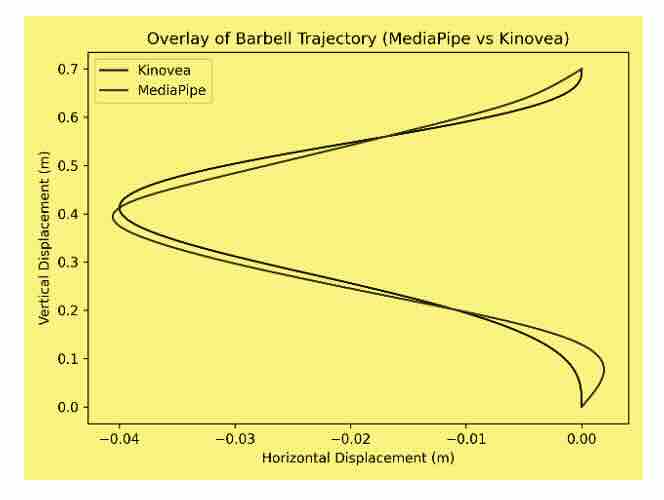
The aim of this research was to evaluate how well the MediaPipe performs in comparison to Kinovea in analyzing key kinematic parameters in the clean lift movement for physical education students, and how reliable the MediaPipe is in doing so. The research design used in this study was descriptive, combined with both comparative and correlational research approaches. The researchers recruited 30 first-year physical education students at the College of Physical Education and Sports Sciences and conducted an experiment on their clean lift movement, captured by high-speed cameras and analyzed using both the MediaPipe and Kinovea. The data analyzed included the knee, hip, and ankle joint angles, and barbell movement, such as vertical velocity, vertical displacement, and bar path. The data analysis involved the use of descriptive statistics, Pearson correlation, intraclass correlation, root mean square error, paired t-test, and Bland-Altman plots. The findings showed that the MediaPipe and Kinovea are highly comparable, particularly in analyzing the velocity of the barbell, where the correlation coefficient between the two tools was 0.96, showing high concurrent validity. There were no significant differences between the two methods. The reliability of the MediaPipe in analyzing the kinematics of the clean lift movement was high, as the correlation coefficient ranged between 0.85 and 0.91, showing high stability in the measurements. The analysis of the bar path movement showed high comparability between the two methods. The conclusion drawn from the research is that the MediaPipe is an effective and affordable tool for analyzing the kinematics of the clean lift movement and thus can be used in both educational and research settings.
References
Bland, J. M., & Altman, D. G. (1986). Statistical methods for assessing agreement between two methods of clinical measurement. The Lancet, 327(8476), 307–310. https://doi.org/10.1016/S0140-6736(86)90837-8
Haff, G. G., & Triplett, N. T. (2016). Essentials of strength training and conditioning (4th ed.). Human Kinetics. https://books.google.com/books?id=bfuXCgAAQBAJ
Jyothi, P. A., Anurag, A., Gagan, G., et al. (2024). Pose Fit: ML powered fitness application. In Proceedings of the IEEE SPARC Conference. https://ieeexplore.ieee.org
Koo, T. K., & Li, M. Y. (2016). A guideline of selecting and reporting intraclass correlation coefficients for reliability research. Journal of Chiropractic Medicine, 15(2), 155–163. https://doi.org/10.1016/j.jcm.2016.02.012
MediaPipe BlazePose. (2020). On-device real-time body pose tracking. Google AI Blog. https://ai.googleblog.com/2020/08/on-device-real-time-body-pose-tracking.html
Olubayode, O. (2025). Bio-feeding and monitoring analysis in sports using MediaPipe pose estimation with AI. GitHub. Retrieved December 5, 2025, from https://github.com/Olubayode/Bio-feeding_And_Monitoring_Analysis_In_Sports_Health_Using_MediaPipe_Pose-_Estimation_with_AI
Sandau, I., Chaabene, H., & Granacher, U. (2021). Concurrent validity of barbell force measured from video-based barbell kinematics during the snatch in male elite weightlifters. PLOS ONE, 16(6). https://doi.org/10.1371/journal.pone.0254705
Stone, M. H., Stone, M., & Sands, W. A. (2007). Principles and practice of resistance training. Human Kinetics. https://www.researchgate.net/publication/249009028_Principles_and_Practice_of_Resistance_Training
Thiele, F., Paternoster, F. K., Hummel, C., et al. (2024). Assessment of the accuracy of a deep learning algorithm- and video-based motion capture system in estimating snatch kinematics. International Journal of Exercise Science. https://pubmed.ncbi.nlm.nih.gov/39807293/
Werner, I., Szelenczy, N., Wachholz, F., et al. (2020). How do movement patterns in weightlifting (clean) change when using lighter or heavier barbell loads? Figshare dataset. https://figshare.com