Lateral Thinking According to Brain Dominance Patterns and its Relationship to the Accuracy of Complex Skill Performance Among Football Students
DOI:
https://doi.org/10.66968/e2gf2522Keywords:
Brain Dominance, Lateral Thinking, Complex Skill Performance, Football, University of Samarra.Abstract
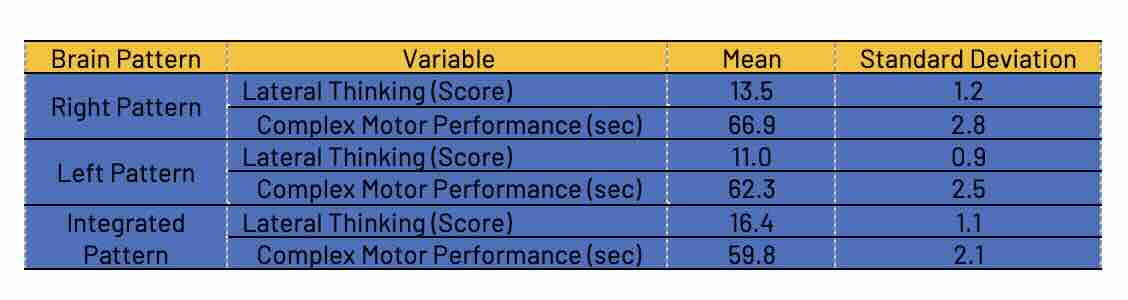
This study aimed to examine the relationship between brain dominance tendencies and an individual’s creative thinking ability, as well as its impact on high level performance in football. The participants consisted of 59 third year students from the College of Physical Education and Sports Sciences at the University of Samarra. A descriptive research design with a correlational approach was employed. All participants were assessed using the Torrance Brain Dominance Scale to classify them into three categories: right-brain dominant (22 students), left-brain dominant (19 students), and integrated (both right and left-brain dominant) (18 students). Lateral thinking ability was measured using the Lateral Thinking Scale developed by Al-Qazwini. In addition, four performance tests previously developed and standardized for the same sample were used to assess skill performance. The results revealed a statistically significant negative (inverse) correlation between lateral thinking ability and final skill performance across all brain dominance patterns. The integrated group demonstrated the best performance, with a mean lateral thinking score of 16.4 and an average performance time of 59.8 seconds. This group also showed the strongest negative correlation coefficient (r = -0.63; p = 0.006). In contrast, the left-brain dominant group exhibited the weakest correlation (r = -0.38). Based on these findings, it can be concluded that integrated brain dominance enhances an individual’s ability to process complex skills. This advantage is reflected in faster response times, greater accuracy, and improved execution of innovative actions under test conditions, resulting from the effective integration of both left and right brain functions.
References
Abdul-Hussein, W. S. (2014). Brain-Compatible Learning. Beirut: Dar Al-Kutub Al-Ilmiyah.
Abu Ubaidah, Hassan Al-Sayyid. (2015). Skill preparation for football players between theory and application. Mahy for Publishing and Distribution, Alexandria, Egypt.
Al-Douri, Abdulrazzaq Abdullah Ibrahim. (2014). Constructing a battery of endurance tests for youth football players in Salah al-Din Governorate (Unpublished doctoral dissertation). College of Physical Education and Sport Sciences, University of Mosul, Iraq.
Al-Hayali, M. H. Y. (2016). The effect of different specific training areas according to game play analysis on complex skill performance, aerobic and anaerobic capacities, and fatigue index for young soccer players (Unpublished doctoral dissertation). College of Physical Education and Sports Science, University of Mosul, Iraq.
Al-Qazwini, A. (2013). Lateral thinking and its relationship with cognitive preference among university students (Unpublished master's thesis). College of Education, University of Al-Qadisiyah, Iraq.
Davids, K., Button, C., & Bennett, S. (2008). Dynamics of skill acquisition: A constraints-led approach. Human Kinetics.
De Bono, E. (1970). Lateral Thinking: Creativity Step by Step. New York: Harper & Row.
Ericsson, K. A., Charness, N., Feltovich, P. J., & Hoffman, R. R. (Eds.). (2006). The Cambridge handbook of expertise and expert performance. Cambridge University Press. https://doi.org/10.1017/CBO9780511816796
Furley, P., & Memmert, D. (2015). Creativity and working memory capacity in sports: working memory capacity is not a limiting factor in creative decision making amongst skilled performers. Frontiers in psychology, 6, 115. https://doi.org/10.3389/fpsyg.2015.00115
Gazzaniga M. S. (2000). Cerebral specialization and interhemispheric communication: does the corpus callosum enable the human condition?. Brain : a journal of neurology, 123 ( Pt 7), 1293–1326. https://doi.org/10.1093/brain/123.7.1293 http://dx.doi.org/10.1016/j.psychsport.2014.05.005
Jacobson, J., & Matthaeus, L. (2014). Athletics and Executive Functioning: How Athletic Participation and Sport Type Correlate with Cognitive Performance. Psychology of Sport and Exercise, 15, 521-527.
Loffing, Florian & Hagemann, Norbert & Strauss, Bernd & MacMahon, Clare. (2016). Laterality in Sports: Theories and Applications (Ed.). https://doi.org/10.1016/B978-0-12-801426-4.01001-4
Memmert, D., & Roca, A. (2019). Tactical creativity and decision making in sport. In A. M. Williams & R. C. Jackson (Eds.), Anticipation and decision making in sport (pp. 203–214). Routledge/Taylor & Francis Group. https://doi.org/10.4324/9781315146270-11
Memmert, D., & Roth, K. (2007). The effects of non-specific and specific concepts on tactical creativity in team ball sports. Journal of Sports Sciences, 25(12), 1423–1432. https://doi.org/10.1080/02640410601129755
Nielsen, J. A., Zielinski, B. A., Ferguson, M. A., Lainhart, J. E., & Anderson, J. S. (2013). An evaluation of the left-brain vs. right-brain hypothesis with resting state functional connectivity magnetic resonance imaging. PloS one, 8(8), e71275. https://doi.org/10.1371/journal.pone.0071275
Raab, M. (2003). Decision making in sports: Influence of complexity on implicit and explicit learning. International Journal of Sport and Exercise Psychology, 1(4), 406–433. https://doi.org/10.1080/1612197X.2003.9671728
Schmidt, R. A., & Wrisberg, C. A. (2008). Motor Learning and Performance: A Situation-Based Learning Approach (4th ed.). Champaign, IL: Human Kinetics.
Serrien, D. J., Ivry, R. B., & Swinnen, S. P. (2006). Dynamics of hemispheric specialization and integration in the context of motor control. Nature reviews. Neuroscience, 7(2), 160–166. https://doi.org/10.1038/nrn1849
Sperry, R. W. (1968). Hemisphere deconnection and unity in conscious awareness. American Psychologist, 23(10), 723–733. https://doi.org/10.1037/h0026839
Voss, M. W., Kramer, A. F., Basak, C., Prakash, R. S., & Roberts, B. (2010). Are Expert Athletes “Expert” in the Cognitive Laboratory? A Meta-Analytic Study of Cognition and Sport Expertise. Applied Cognitive Psychology, 24, 812-826.http://dx.doi.org/10.1002/acp.1588
Ward, P., & Williams, A. M. (2003). Perceptual and Cognitive Skill Development in Soccer: The Multidimensional Nature of Expert Performance. Journal of Sport and Exercise Psychology, 25(1), 93-111. Retrieved Mar 7, 2026, from https://doi.org/10.1123/jsep.25.1.93
Williams, A. M., & Ford, P. R. (2009). Promoting a skills-based agenda in Olympic sports: The role of skill-acquisition specialists. Journal of Sports Sciences, 27(13), 1381–1392. https://doi.org/10.1080/02640410902874737
Wulf, G., & Shea, C. H. (2002). Principles derived from the study of simple skills do not generalize to complex skill learning. Psychonomic bulletin & review, 9(2), 185–211. https://doi.org/10.3758/bf03196276