
The Relationship Between Sleep Quality Heart Rate Variability (HRV) and Functional Recovery in Players at the Samarra Basketball Club
DOI:
https://doi.org/10.66968/f457bc03Keywords:
Quality of sleep, Heart Rate Variability (HRV), Functional Restoration, Basketball athletes, Samarra Basketball ClubAbstract
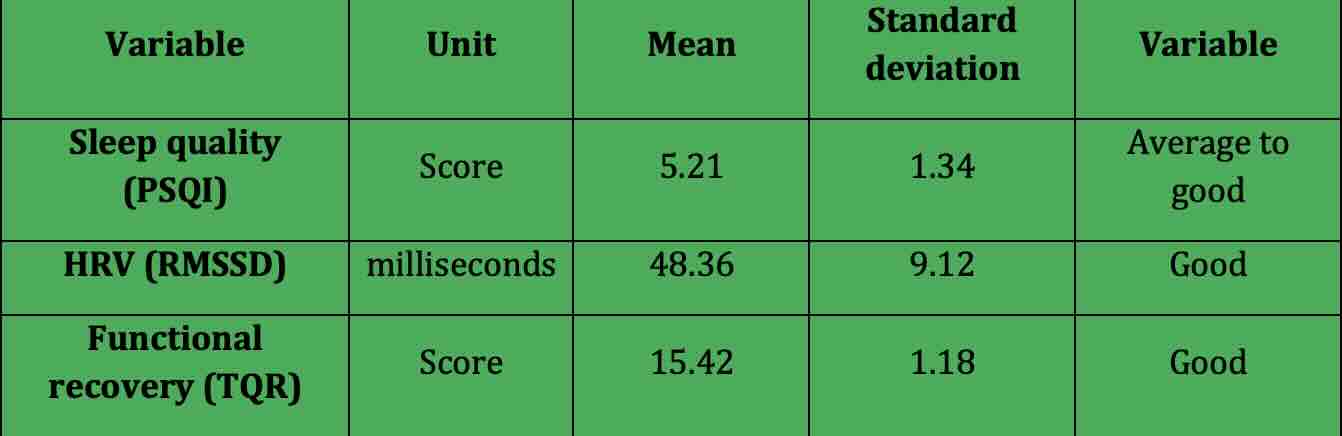
This study examined the relationship between sleep quality, heart rate variability (HRV) and the level of functional recovery among players at the Samarra basketball club. The researcher adopted a descriptive, correlational approach, in line with the nature of the research problem and the objectives the study aimed to achieve. The study population consisted of the players in the first team of the Samarra Basketball Club for the 2025–2026 season, totalling 14 players. Given the small size of the population, the research procedures covered all the players, representing 100 per cent of the initial population. To assess the sleep quality of the sample members, the researcher used the Pittsburgh Sleep Quality Index (PSQI), whilst heart rate variability (HRV) was measured using the RMSSD and SDNN indices. The Functional Recovery Scale (TQR) was also used to assess the players’ level of recovery following training sessions. The measurement tools used included a heart rate monitor, dedicated HRV measurement apps, as well as data-recording questionnaires and SPSS software for data processing and statistical analysis. The results showed that the club’s players exhibited relatively good levels with regard to the variables of sleep quality, heart rate variability and functional recovery. A positive and statistically significant correlation was also observed between sleep quality and HRV (0.71), as well as between sleep quality and functional recovery (0.76), whilst the correlation between HRV and functional recovery reached a correlation coefficient of 0.81. Furthermore, the variables of sleep quality and HRV together accounted for 68 per cent of the variance observed in the players’ functional recovery. These results highlight the importance of using sleep indicators and heart rate variability to monitor the functional status, level of recovery and physical condition of basketball players, as well as the potential to use them to monitor fatigue and stress associated with training loads.
References
Abbas Fadel Al-Dulaimi, Methods of Scientific Research in Physical Education, Baghdad: University of Baghdad, 2014.
Abdul Ali Nasif, Physiology of Sports Training, Baghdad: University of Baghdad, 2017.
Bompa, T. & Haff, G., Periodisation: Theory and Methodology of Training, Human Kinetics, 2009.
Buchheit, M., “Monitoring Training Status with HR Measures”, Frontiers in Physiology, Vol. 5, 2014.
Fullagar, H. et al., “Sleep and Athletic Performance”, Sports Medicine, Vol. 45, 2015.
Hynynen, E. et al., “The Effects of Sleep on Heart Rate Variability”, Journal of Sports Sciences, Vol. 29, 2011.
Kellmann, M., Enhancing Recovery: Preventing Underperformance in Athletes, Human Kinetics, 2002.
Kraemer, W. J. & Ratamess, N. A., Fundamentals of Resistance Training, Human Kinetics, 2004.
Li, Q. et al., “Pre-sleep Heart Rate Variability Predicts Chronic Insomnia”, Frontiers in Physiology, 2025.
Mohammed Hassan Alawi, Scientific Research Methods in Physical Education, Cairo: Dar al-Fikr al-Arabi, 2017.
Mohammed Nasr al-Din Radwan, Statistics in Physical Education, Cairo: Dar al-Fikr al-Arabi, 2006.
Plews, D. et al., “Heart Rate Variability in Elite Athletes”, European Journal of Applied Physiology, Vol. 113, 2013.
Qasim Hassan Hussein, Sports Training in Team Sports, Baghdad: Higher Education Press, 2016.
Reilly, T. & Edwards, B., “Altered Sleep-Wake Cycles and Physical Performance”, Biological Rhythm Research, Vol. 38, 2007.
Rygielski, A. et al., “The Impact of Sleep on Athletes’ Performance and Injury Risk”, 2024.
Sánchez, R. P., “Heart Rate Variability in Basketball”, Applied Sciences, 2024.
Suleiman, K. et al., “Psychometric Properties of the Arabic PSQI”, Sleep and Breathing Journal, Vol. 14, 2010.
Task Force of the European Society of Cardiology, “Heart Rate Variability: Standards of Measurement”, European Heart Journal, Vol. 17, 1996.
Wajih Mahjoub, Scientific Research and its Methods, Baghdad: Dar al-Hikma, 2012.
Wilmore, J. & Costill, D., Physiology of Sport and Exercise, Human Kinetics, 2004.
Downloads
Published
Issue
Section
License
Copyright (c) 2026 Ayad Ghani Jasim (Author)

This work is licensed under a Creative Commons Attribution-ShareAlike 4.0 International License.