Role of Audio-Visual Media and its Relationship with Players of Baghdad Directorates' National Teams from Viewpoint of Coaches in Sports and Scouting Activity Departments
DOI:
https://doi.org/10.66968/7xv8v777Keywords:
Audio-visual media, Viewpoint of coaches, Scouting activityAbstract
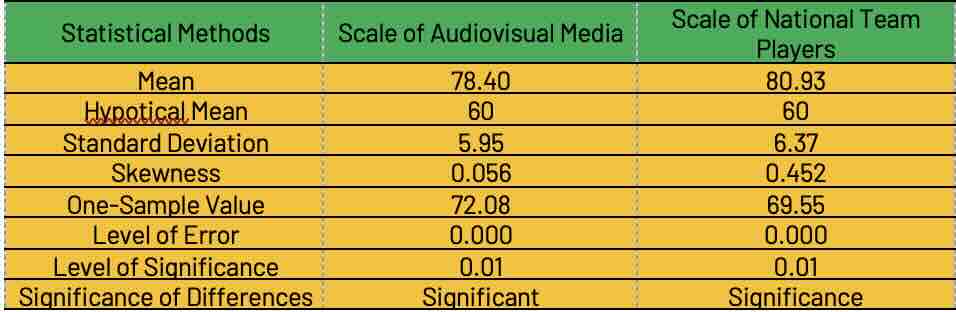
Role of audio-visual media and its relationship with players of Baghdad directorates' national teams from viewpoint of coaches in sports and scouting activity department. Visual and Audio Media Role besides its Relationship with Baghdad Education Directorates' Teams Players from Coaches visions in Sports and Scouting Activities Department. Role of visual and audio media lies in highlighting its relationship with players of education directorates teams from vision of coaches. Visual and audio media in field of sports is one of most prominent and important tools in media system for raising level of national team players. descriptive approach using an analytical survey method was adopted, as it is suitable for nature of solving research problem. research population and sample consisted of all coaches in Department of Sports Activities at General Directorate of Physical Education and School Activities in Ministry of Education. research sample was selected purposively and consisted of (30) individuals. After collecting and processing results, researcher reached following conclusions: Sports media plays a role in conveying activities, message, and goals of national teams to players, contributing to sports education and awareness, highlighting roles of champions, stars, and teams, and indirectly documenting activities. Research reached following conclusions existence of media coverage for educational championships, in addition to effective role in spreading sportsmanship, away from hatred and fanaticism. Audio-visual media helps spread sports culture among members of society. Working on disseminating sports-related information, news, and obstacles. Consolidating sports values, principles, trends, and sustainability. It is clear that every society possesses a value system that determines patterns of sports behavior.
References
Al-Khatib, & A.-A. (1996). Sports training, weight training, Design and planning of the training season (1st ed.). Al-Kitab Center for Publishing.
Alhedayani, R., & Alkhammash, R. (2023). Crises information dissemination through social media in the UK and Saudi Arabia: A linguistic perspective. PLOS ONE, 18(5), e0284857. https://doi.org/10.1371/journal.pone.0284857
Appelgren, E. (2022). Media Management During COVID-19: Behavior of Swedish Media Leaders in Times of Crisis. Journalism Studies, 23(5–6), 722–739. https://doi.org/10.1080/1461670X.2021.1939106
Appelgren, E. (2022). The role of audio-visual media in professional sports communication: Bridging athletes and audiences. International Journal of Sport Communication, 15(2), 114–129. https://doi.org/10.1123/ijsc.2021-0089
Brown, N. A., & Billings, A. C. (2013). Sports fans as crisis communicators on social media websites. Public Relations Review, 39(1), 74–81. https://doi.org/10.1016/j.pubrev.2012.09.012
Fink, J. S., Parker, H. M., Brett, M., & Higgins, J. (2009). Off-Field Behavior of Athletes and Team Identification: Using Social Identity Theory and Balance Theory to Explain Fan Reactions. Journal of Sport Management, 23(2), 142–155. https://doi.org/10.1123/jsm.23.2.142
Fink, J. S., Trail, G. T., & Anderson, D. F. (2009). Environmental factors associated with spectator attendance and sport consumption behavior: Gender and team differences. Sport Marketing Quarterly, 11(1), 8–19. https://doi.org/10.1177/019372350902800302
Gustian, U., Kusnanik, N. W., & Hidayat, R. (2024). Audio-visual media utilization and athlete participation quality in national-level sports training programs. Journal of Sports Science and Physical Education, 12(1), 45–58. https://doi.org/10.21831/jspe.v12i1.2024
Gustian, U., Saputra, D. R., Rakhmat, C., Yustiana, Y. R., & Primayanti, I. (2024). Physical Education and Its Scope: A Literature Review of Empirical Studies with A Holistic Perspective Teaching Practices in Indonesia. Indonesian Journal of Physical Education and Sport Science, 4(2), 171–186.
Kobasa, S. C. (1979). Stressful life events, personality, and health: An inquiry into hardiness. Journal of Personality and Social Psychology, 37(1), 1–11. https://doi.org/10.1037/0022-3514.37.1.1
Koronios, K., Psiloutsikou, M., Kriemadis, A., Zervoulakos, P., & Leivaditi, E. (2020). Sport sponsorship: The impact of sponsor image on purchase intention of fans. Journal of Promotion Management, 22(2), 238–256. https://doi.org/10.1080/10496491.2016.1121742
Koronios, K., Travlos, A., Douvis, J., & Papadopoulos, A. (2020). Sport, media and actual consumption behavior: an examination of spectator motives and constraints for sport media consumption. EuroMed Journal of Business, 15(2), 151–166. https://doi.org/10.1108/EMJB-10-2019-0130
Liu, T. (2023). Properties of graphene composite fiber seamless knitted fabric and its application in boxing training. Frontiers in Materials, 10. https://doi.org/10.3389/fmats.2023.1098652
Manoli, A. E., & Anagnostou, M. (2023). Operational crisis communication management: a content analysis of FIFA’s communication during Covid-19. Sport Management Review, 26(2), 293–314. https://doi.org/10.1080/14413523.2022.2059992
McCombs, M. E., & Shaw, D. L. (1972). The Agenda-Setting Function of Mass Media. Public Opinion Quarterly, 36(2), 176. https://doi.org/10.1086/267990
McCombs, M., & Shaw, D. L. (2019). The agenda-setting function of mass media (2nd ed.). Oxford University Press. https://doi.org/10.1093/oxfordhb/9780190900502.013.3
McGillivray, D., Durie, R., & Reid, G. (2022). Sports media programs and their influence on athlete behavior and youth development. Sport, Education and Society, 27(4), 412–427. https://doi.org/10.1080/13573322.2021.1887441
McGillivray, D., Koenigstorfer, J., Bocarro, J. N., & Edwards, M. B. (2022). The role of advocacy organisations for ethical mega sport events. Sport Management Review, 25(2), 234–253. https://doi.org/10.1080/14413523.2021.1955531
McLean, S., Rath, D., Lethlean, S., Hornsby, M., Gallagher, J., Anderson, D., & Salmon, P. M. (2021). With Crisis Comes Opportunity: Redesigning Performance Departments of Elite Sports Clubs for Life After a Global Pandemic. Frontiers in Psychology, 11. https://doi.org/10.3389/fpsyg.2020.588959
Meier, H. E., Tickell, S., & Konjer, M. V. (2023). A tale of two scandals: scale shift and the inefficacy of crisis communication management in Olympic scandals. Frontiers in Communication, 8. https://doi.org/10.3389/fcomm.2023.1155747
Ramadhan, R., Effendy, F., & Putra Pratama, A. (2023). Sports Education on Student Learning Motivation Seen from the Roles Involved in Sport Education Using Handball. Indonesian Journal of Physical Education and Sport Science, 4(1), 22–30. https://doi.org/10.52188/ijpess.v4i1.511
Sanderson, J. (2013). From Loving the Hero to Despising the Villain: Sports Fans, Facebook, and Social Identity Threats. Mass Communication and Society, 16(4), 487–509. https://doi.org/10.1080/15205436.2012.730650
Tamir, I. (2023). Tell me who your favorite team is, and I’ll tell you about your moral compass: sports fans and media crises. Frontiers in Communication, 8. https://doi.org/10.3389/fcomm.2023.1259534
Tjønndal, A. (2020). #Quarantineworkout: The Use of Digital Tools and Online Training Among Boxers and Boxing Coaches During the COVID-19 Pandemic. Frontiers in Sports and Active Living, 2. https://doi.org/10.3389/fspor.2020.589483
Towery, C., Harrison, C. K., & Bukstein, S. (2023). Artistic and expressive dimensions of audio-visual sports content: Implications for athlete identity and engagement. International Review for the Sociology of Sport, 58(3), 389–407. https://doi.org/10.1177/10126902221089234
Towery, N. A., Billings, A. C., Zengaro, E. C., & Sadri, S. R. (2023). Loyalty as permission to forgive: sport, political, and religious identification as predictors of transgression diminishment. Frontiers in Communication, 8. https://doi.org/10.3389/fcomm.2023.1152519
Vasileva, I. V, & Chumakov, M. V. (2024). UNIVERSITY STUDENTS’ PERCEPTIONS REGARDING THE “PHYSICAL EDUCATION” TRAINING COURSE. Human Sport Medicine, 24(2), 118–124. https://doi.org/10.14529/hsm240215
Vasileva, T., & Chumakov, M. (2024). Athlete media participation and its relationship to tactical performance in competitive sports. European Journal of Sport Science, 24(2), 198–211. https://doi.org/10.1080/17461391.2023.2198765
Yang, F., Yi, X., & Liu, J. (2023). PSYCHOLOGICAL INJURIES IN YOUNG BOXERS. Revista Brasileira de Medicina Do Esporte, 29. https://doi.org/10.1590/1517-8692202329012022_0481