Directional Reversal Locomotor Training: Effects on Executive Function and Dynamic Balance in Children Aged 6–7 Years
DOI:
https://doi.org/10.66968/v0jt9d94Keywords:
Inhibitory Control, School Interventionmotor, Motor-Cognitive Integration, Dynamic Postural Control, HTKS-R test; YBT-LQ testAbstract
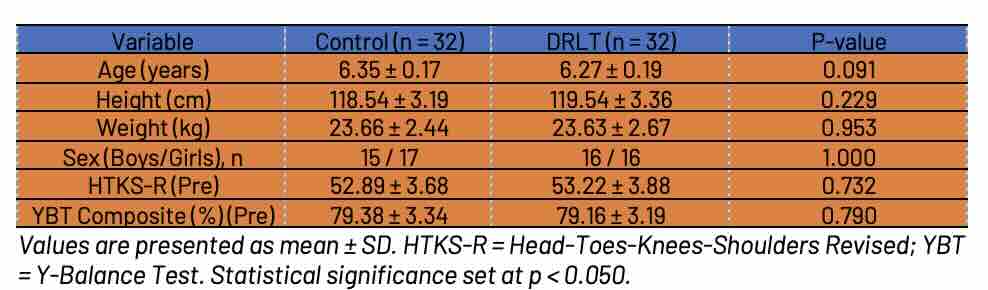
Cognitively enhanced physical activity could contribute to improving the executive functions for children. However, the particularity of motor-cognitive adaptations throughout various fields are still not clear. The current study aims at examining the impact of directional reversal locomotor training (DRLT) on executive functions and dynamic balance for the stage of early school children. In a randomized controlled trial, 64 first-grade children (with ages 6–7 years) were distributed to the DRLT group (n = 32) or the group, which takes regular physical education classes (n = 32) for 8 weeks. Executive functions were assessed using HTKS-R test and the dynamic balance was assessed using the Y-Balance Test – Lower Quarter. Results after intervention were analyzed using the Analysis of Covariance (ANCOVA). DRLT program demonstrated a significant improvement in executive functions (p < 0.001; effect size d = 2.04), but no significant effect was observed in dynamic balance (p = 0.864; d = 0.13). The results support the domain-specific nature of motor-cognitive adaptations in school interventions.
References
1abcde, A. I., Jamal, K., 1abde, M., Mahmood, A., 1abde, M., Dhayea, T., Saad, M., 2abd, J., Fawzı, Y., & 3abde, G. (n.d.). Stroop-based locomotor training improves executive attention and running in preschoolers. https://doi.org/10.15561/26649837.2026.0303
Barsalou, L. W. (2008). Grounded cognition. Annual Review of Psychology, 59, 617–645. https://doi.org/10.1146/annurev.psych.59.103006.093639
Brumitt, J., Patterson, C., Dudley, R., Sorenson, E., Hill, G., & Peterson, C. (2019). Comparison Of Lower Quarter Y-Balance Test Scores For Female Collegiate Volleyball Players Based On Competition Level, Position, And Starter Status. International Journal of Sports Physical Therapy, 14(3), 415–423. https://doi.org/10.26603/ijspt20190415
Crova, C., Struzzolino, I., Marchetti, R., Masci, I., Vannozzi, G., Forte, R., & Pesce, C. (2014). Cognitively challenging physical activity benefits executive function in overweight children. Journal of Sports Sciences, 32(3), 201–211. https://doi.org/10.1080/02640414.2013.828849
de Greeff, J. W., Bosker, R. J., Oosterlaan, J., Visscher, C., & Hartman, E. (2018). Effects of physical activity on executive functions, attention and academic performance in preadolescent children: a meta-analysis. In Journal of Science and Medicine in Sport (Vol. 21, Number 5, pp. 501–507). Elsevier Ltd. https://doi.org/10.1016/j.jsams.2017.09.595
Diamond, A. (2013). Executive functions. In Annual Review of Psychology (Vol. 64, pp. 135–168). Annual Reviews Inc. https://doi.org/10.1146/annurev-psych-113011-143750
Diamond, A., & Ling, D. S. (2016). Conclusions about interventions, programs, and approaches for improving executive functions that appear justified and those that, despite much hype, do not. Developmental Cognitive Neuroscience, 18, 34–48. https://doi.org/10.1016/j.dcn.2015.11.005
Egger, F., Benzing, V., Conzelmann, A., & Schmidt, M. (2019). Boost your brain, while having a break! The effects of long-term cognitively engaging physical activity breaks on children’s executive functions and academic achievement. PLoS ONE, 14(3). https://doi.org/10.1371/journal.pone.0212482
Gonzales, C. R., Bowles, R., Geldhof, G. J., Cameron, C. E., Tracy, A., & McClelland, M. M. (2021). The Head-Toes-Knees-Shoulders Revised (HTKS-R): Development and psychometric properties of a revision to reduce floor effects. Early Childhood Research Quarterly, 56, 320–332. https://doi.org/10.1016/j.ecresq.2021.03.008
Gribble, P. A., Hertel, J., & Plisky, P. (2012). Using the star excursion balance test to assess dynamic postural-control deficits and outcomes in lower extremity injury: A literature and systematic review. In Journal of Athletic Training (Vol. 47, Number 3, pp. 339–357). https://doi.org/10.4085/1062-6050-47.3.08
Ibrahim, A., Jasim, A. G., Hawar, A. B., Ghaeb, Y. F., & Alsamarae, M. S. K. (2025). Effect of HTKS-R–inspired visual reversal motor play on self-regulation and motor skills in preschoolers. Retos, 73, 1145–1155. https://doi.org/10.47197/retos.v73.117771
Koziol, L. F., Budding, D. E., & Chidekel, D. (2011). Sensory integration, sensory processing, and sensory modulation disorders: Putative functional neuroanatomic underpinnings. Cerebellum, 10(4), 770–792. https://doi.org/10.1007/s12311-011-0288-8
Koziol, L. F., Budding, D. E., & Chidekel, D. (2012). From movement to thought: Executive function, embodied cognition, and the cerebellum. Cerebellum, 11(2), 505–525. https://doi.org/10.1007/s12311-011-0321-y
Lakens, D. (2013). Calculating and reporting effect sizes to facilitate cumulative science: A practical primer for t-tests and ANOVAs. Frontiers in Psychology, 4(NOV). https://doi.org/10.3389/fpsyg.2013.00863
Liu, S., Yu, Q., Li, Z., Cunha, P. M., Zhang, Y., Kong, Z., Lin, W., Chen, S., & Cai, Y. (2020). Effects of Acute and Chronic Exercises on Executive Function in Children and Adolescents: A Systemic Review and Meta-Analysis. In Frontiers in Psychology (Vol. 11). Frontiers Media S.A. https://doi.org/10.3389/fpsyg.2020.554915
Lu, Z., Zhou, L., Gong, W., Chuang, S., Wang, S., Guo, Z., Bao, D., Zhang, L., & Zhou, J. (2022). The Effect of 6-Week Combined Balance and Plyometric Training on Dynamic Balance and Quickness Performance of Elite Badminton Players. International Journal of Environmental Research and Public Health, 19(3). https://doi.org/10.3390/ijerph19031605
Mao, F., Huang, F., Zhao, S., & Fang, Q. (2024). Effects of cognitively engaging physical activity interventions on executive function in children and adolescents: a systematic review and meta-analysis. In Frontiers in Psychology (Vol. 15). Frontiers Media SA. https://doi.org/10.3389/fpsyg.2024.1454447
Mavilidi, M. F., Pesce, C., Mazzoli, E., Bennett, S., Paas, F., Okely, A. D., & Howard, S. J. (2023). Effects of Cognitively Engaging Physical Activity on Preschool Children’s Cognitive Outcomes. Research Quarterly for Exercise and Sport, 94(3), 839–852. https://doi.org/10.1080/02701367.2022.2059435
Mazzoli, E., Salmon, J., Teo, W. P., Pesce, C., He, J., Ben-Soussan, T. D., & Barnett, L. M. (2021). Breaking up classroom sitting time with cognitively engaging physical activity: Behavioural and brain responses. PLoS ONE, 16(7 July). https://doi.org/10.1371/journal.pone.0253733
McClelland, M. M., Gonzales, C. R., Cameron, C. E., Geldhof, G. J., Bowles, R. P., Nancarrow, A. F., Merculief, A., & Tracy, A. (2021). The Head-Toes-Knees-Shoulders Revised: Links to Academic Outcomes and Measures of EF in Young Children. Frontiers in Psychology, 12. https://doi.org/10.3389/fpsyg.2021.721846
Pahor, A., Seitz, A. R., & Jaeggi, S. M. (2022). Near transfer to an unrelated N-back task mediates the effect of N-back working memory training on matrix reasoning. Nature Human Behaviour, 6(9), 1243–1256. https://doi.org/10.1038/s41562-022-01384-w
Paillard, T. (2023). The optimal method for improving postural balance in healthy young and older people: specific training for postural tasks encountered in personal physical practice. In Frontiers in Physiology (Vol. 14). Frontiers Media SA. https://doi.org/10.3389/fphys.2023.1188496
Pesce, C. (2012). Shifting the Focus From Quantitative to Qualitative Exercise Characteristics in Exercise and Cognition Research. In Journal of Sport & Exercise Psychology (Vol. 34). www.JSEP-Journal.com
Schmidt, M., Benzing, V., & Kamer, M. (2016). Classroom-based physical activity breaks and children’s attention: Cognitive engagement works! Frontiers in Psychology, 7(OCT). https://doi.org/10.3389/fpsyg.2016.01474
Song, W., Feng, L., Wang, J., Ma, F., Chen, J., Qu, S., & Luo, D. (2022). Play Smart, Be Smart? Effect of Cognitively Engaging Physical Activity Interventions on Executive Function among Children 4~12 Years Old: A Systematic Review and Meta‐Analysis. In Brain Sciences (Vol. 12, Number 6). MDPI. https://doi.org/10.3390/brainsci12060762
Vazou, S., Pesce, C., Lakes, K., & Smiley-Oyen, A. (2019). More than one road leads to Rome: A narrative review and meta-analysis of physical activity intervention effects on cognition in youth. International Journal of Sport and Exercise Psychology, 17(2), 153–178. https://doi.org/10.1080/1612197X.2016.1223423
Wang, J., Yang, Y., Li, L., Yang, X., Guo, X., Yuan, X., Xie, T., Yang, K., & Zhuang, J. (2024). Comparative efficacy of physical activity types on executive functions in children and adolescents: A network meta-analysis of randomized controlled trials. In Journal of Science and Medicine in Sport (Vol. 27, Number 3, pp. 187–196). Elsevier Ltd. https://doi.org/10.1016/j.jsams.2023.11.006