Organizational Trust and its Impact on Pedagogical Behavioral Goals in Sports Institutions
DOI:
https://doi.org/10.66968/d57zkt39Keywords:
Organizational trust, Organizational justice, Organizational citizenship behavior, Sports club governance, Job satisfactionAbstract
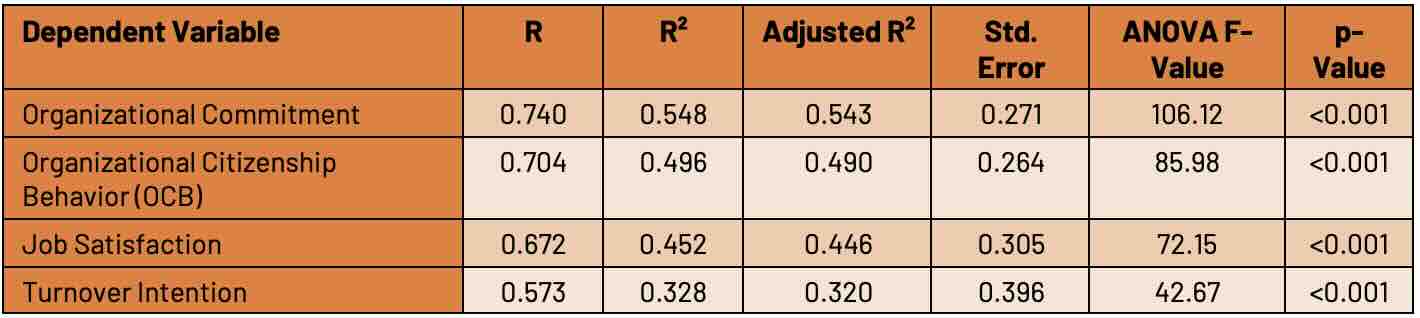
This study investigated the impact of organizational trust grounded in organizational justice perceptions on employees' behavioral outcomes (organizational citizenship behavior [OCB], organizational commitment, job satisfaction, and turnover intention) across sports clubs in Maysan Governorate, Iraq. Employing a descriptive-analytical survey design, data were collected from a reconciled representative sample of 355 administrative personnel, including board members (n = 32), multi-tier administrative staff (n = 128), and general assembly members (n = 195) across five registered sports clubs. Standardized multidimensional scales measuring organizational justice (distributive, procedural, interactional, informational) and behavioral outcomes demonstrated high reliability (Cronbach's α = 0.819–0.865). Bivariate Pearson correlation analysis revealed significant positive associations between organizational trust and OCB (r = 0.684, p < 0.001), organizational commitment (r = 0.718, p < 0.001), and job satisfaction (r = 0.652, p < 0.001), alongside a negative correlation with turnover intention (r = -0.542, p < 0.001). Multiple linear regression indicated that organizational justice dimensions accounted for 54.8% of the variance in organizational commitment (R² = 0.548, F = 106.12, p < 0.001) and 49.6% in OCB (R² = 0.496, F = 85.98, p < 0.001), with procedural and interactional justice exhibiting the strongest predictive contributions (β = 0.382 and β = 0.314, p < 0.001). Independent samples t-tests indicated no significant differences between administrative cadres and general assembly members (t = 0.47–1.87, p > 0.05). In conclusion, cultivating procedural transparency and interpersonal dignity is paramount for sustaining sports institutional loyalty, voluntary citizenship, and administrative retention.
References
Ahmed, I. A. (1998). Behavioral aspects in school administration. Dar Al-Fikr Al-Arabi.
Al-Ameri, A. S. (2003). Determinants and effects of organizational citizenship behavior in organizations. Journal of King Saud University: Administrative Sciences, 15(2), 241–268.
Al-Fahdawi, F. K. S. (2005). The relationship of organizational citizenship behavior with transformational change: A field study of the perceptions of employees of government departments in the city of Karak. Dirasat: Administrative Sciences, 32(2), 312–330.
Colquitt, J. A. (2001). On the dimensionality of organizational justice: A construct validation of a measure. Journal of Applied Psychology, 86(3), 386–400. https://doi.org/10.1037/0021-9010.86.3.386
El-Shafei, H. A. (2005). Organizational trust in the sports field. Dar Al-Wafa for Dunia Printing and Publishing.
Felfe, J., Schmook, R., Schyns, B., & Six, B. (2008). Does the form of employment make a difference? Commitment and strain among temporary, work agency and permanent workers. International Journal of Human Resource Management, 19(7), 1321–1342. https://doi.org/10.1080/09585190802110129
Hamed, S. S. (2002). The impact of personal, organizational, and functional variables on employees' perception of organizational justice. Journal of Commerce and Environmental Studies, 13(1), 35–64.
Hassan, A., & Hashim, J. (2011). Role of organizational justice in determining employee commitment and turnover intention. International Journal of Economics and Management, 5(1), 267–285.
Jaballah, R. M. (1994). Determinants of organizational citizenship behavior: An empirical study. Scientific Journal of Economics and Commerce, 24(1), 11–45.
Locke, E. A. (1976). The nature and causes of job satisfaction. In M. D. Dunnette (Ed.), Handbook of Industrial and Organizational Psychology (pp. 1297–1349). Rand McNally.
Meyer, J. P., & Allen, N. J. (1991). A three-component conceptualization of organizational commitment. Human Resource Management Review, 1(1), 61–89. https://doi.org/10.1016/1053-4822(91)90011-Z
Muharama, T. M. (2008). Organizational citizenship behavior in Qatari government agencies: A field study. Public Administration Journal, 48(2), 189–224.
Podsakoff, P. M., MacKenzie, S. B., Paine, J. B., & Bachrach, D. G. (2000). Organizational citizenship behaviors: A critical review of the theoretical and empirical literature and suggestions for future research. Journal of Management, 26(3), 513–563. https://doi.org/10.1177/014920630002600307
Salmani, D., Radmand, M. A., & Baghestan, A. G. (2011). Perception of social justice implication in Iranian educational institutions. Education, Business and Society: Contemporary Middle Eastern Issues, 4(1), 19–32. https://doi.org/10.1108/17537981111111247
Stecher, M. D., & Rosse, J. G. (2005). The distributive side of interactional justice: The effects of interpersonal treatment on emotional arousal. Journal of Managerial Issues, 17(2), 229–246.
Sultan, M. S. (2003). Human resources management. New University House.
Wittmer, D. P. (2010). Ethical climate in government and sports organizations: Exploring the link between procedural justice and institutional trust. Public Administration Quarterly, 34(3), 329–360.
Yilmaz, K., & Tasdan, M. (2009). Organizational citizenship and organizational justice in Turkish primary schools. Journal of Educational Administration, 47(1), 108–126. https://doi.org/10.1108/09578230910928106
Zoghbi-Manrique-de-Lara, P. (2011). Whether task satisfaction mediates the effect of fair procedures on citizenship. International Journal of Organizational Analysis, 19(3), 222–234. https://doi.org/10.1108/19348831111149187
Downloads
Published
Issue
Section
License
Copyright (c) 2026 Murtadha Kadhim Ibadi (Author)

This work is licensed under a Creative Commons Attribution-ShareAlike 4.0 International License.