
Effectiveness of Virtual Reality-Based Training in Developing Basic Skills Among Table Tennis Players
DOI:
https://doi.org/10.66968/pejuangKeywords:
Virtual reality, Sports training, Table tennis, Basic skills, Skill performanceAbstract
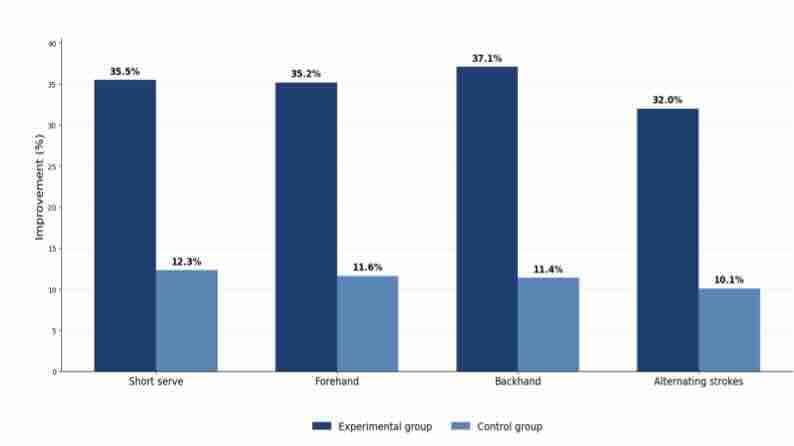
This study examined the effectiveness of virtual reality-based training to enhance selected basic skills short-serve accuracy, straight forehand accuracy, straight backhand accuracy, and alternating forehand-backhand of table tennis players. An experimental pre-test-post-test design with two equivalent groups was used. The sample for the application of the model consisted of 20 junior players aged between 14–16 years. The players were randomly assigned to the experimental group comprising ten players trained in the immersive virtual reality environment while the control group comprised ten players who underwent conventional training. The programmed took place over eight weeks, with three sessions a week. Following the validation and reliability assessment of the tests, the serve accuracy, forehand accuracy, backhand accuracy and continuous alternating strokes tests were performed. Using multiple analyses, the sampled data were analyzed. The analyses include means, standard deviations, t-tests, and effect sizes. Findings from the model indicated statistically significant differences pre–post in all skills for the experimental group and a significant post-test advantage for the experimental group over the control group. The experimental group improved by 35.5% for the serve, 35.2% for the forehand, 37.1% for the backhand and 32.0% for alternating strokes, with large effect sizes. This may be explained by frequent repetitions, immediate feedback, control of ball speed and direction, and the motivation of players being enhanced in the virtual environment. The overall conclusion of the study is that virtual reality, while a useful aid, is not a replacement for practicing in person. It is advised to start using it in junior table tennis programmed gradually, keeping safety and individual differences in mind.
References
Abdel-Hussein, W. S. (2021). Special exercises and assistive devices for developing selected motor abilities and the accuracy of basic skills among racket-sport players. Journal of Humanities and Sports Sciences.
Abdel-Karim, J. N. (2019). Racket sports: Table tennis and badminton. Open Educational College, Department of Physical Education and Sport Sciences. https://www.ta4a.us/individual-sports/tournament-games/
Adib, J. N., Hossam El-Din, A. T., Abdel-Meguid, H. H., & Mohamed, M. S. H. (2022). The effect of an augmented reality-based instructional programme on learning the straight forehand stroke in table tennis. Journal of Theories and Applications of Physical Education and Sport Sciences, 37(2), 216–237. https://journals.ekb.eg/article_185409.html
Al-Jamsi, H. J. A. (2022). The effect of the generative model on learning selected basic skills and cognitive achievement in table tennis. Assiut Journal of Sport Science and Arts of Physical Education. https://search.mandumah.com/Search/Results?lookfor=النموذج+التوليدي+تنس+الطاولة
Al-Sabbagh, O. (n.d.). Table tennis. Arab Electronic Library. https://aialibrary.com/product/تنس-الطاولة/
Dheeb, M. A., & Al-Bakri, T. (2015). Virtual reality simulation and its effect on competition anxiety and performance among table tennis players. Journal of Educational and Psychological Studies, 9(2), 325–339. https://doi.org/10.24200/jeps.vol9iss2pp325-339
Hatim, A. D. (2018). Tests of offensive and defensive skills in table tennis. Amman: Arab Community Library for Publishing and Distribution. https://www.researchgate.net/publication/328201812
Ibrahim, A. A. M. (2018). The effect of brainstorming on creating assistive devices and innovative exercises and on beginners’ skill performance in table tennis. Journal of Sports Science Applications
Ma, T., Zhang, Y., Li, H., & Wang, J. (2024). The effect of virtual reality technology in table tennis education: A randomized controlled trial. Sensors, 24(21), 7041. https://doi.org/10.3390/s24217041
Mahna, D. A. (2020). The effect of motor-coordination exercises on the accuracy of selected basic table tennis skills among female racket-sports teaching students. Assiut Journal of Sport Science and Arts of Physical Education, Special Issue, 2864–2880. https://doi.org/10.21608/JPRR.2020.151157
Michalski, S. C., Szpak, A., Saredakis, D., Ross, T. J., Billinghurst, M., & Loetscher, T. (2019). Getting your game on: Using virtual reality to improve real table tennis skills. PLOS ONE, 14(9), e0222351. https://doi.org/10.1371/journal.pone.0222351
Mohamed, M. S. (2023). An analytical study of selected biomechanical variables in straight and diagonal forehand performance and their relationship with accuracy among table tennis players. Journal of Sport Sciences.
Sharaf al-Din, A. W. (2023). The effect of virtual reality technology on learning selected table tennis skills among students at the Faculty of Physical Education, Benha University. Journal of Physical Education Research. https://journals.ekb.eg/article_450112.html
Škopek, M., Heidler, J., Balkó, Š., Vojtíková, L., & Ulrichová, R. (2024). Evaluation of the influence of training in an immersive virtual reality environment on sports skills in table tennis. Baltic Journal of Health and Physical Activity, 16(3), Article 5. https://doi.org/10.29359/BJHPA.16.3.05
Youssef, M. A. (2024). The effectiveness of mobile learning for cognitive achievement and skill performance in selected table tennis skills. Journal of Sport Sciences and Physical Education Applications. https://journals.ekb.eg/article_383382.html
Downloads
Published
Issue
Section
License
Copyright (c) 2026 Hamdullah Abed Hammadi (Author)

This work is licensed under a Creative Commons Attribution-ShareAlike 4.0 International License.