A Comparative Study of Positive and Negative Thinking Among Students at Al-Nusour University Who Participate and Do Not Participate in Sports Activities
DOI:
https://doi.org/10.66968/pejuangKeywords:
Positive Thinking, Negative Thinking, Sporting Activities, University Students, Al-Nusoor UniversityAbstract
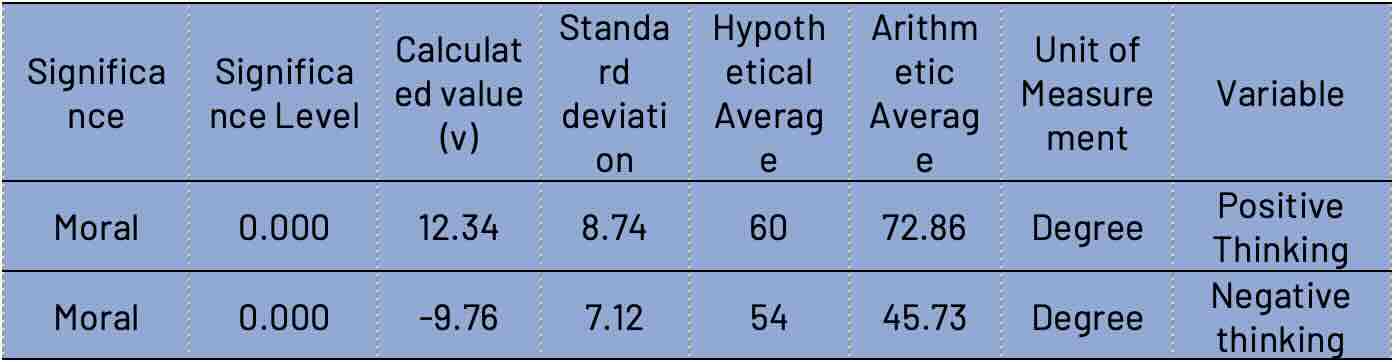
The aim of this study was to identify the levels of positive and negative thinking among students at Al-Nusoor University, and to reveal differences between students who do and do not participate in sporting activities with regard to these two variables. The researcher adopted a descriptive approach using a comparative study design, as this was deemed appropriate for the nature and objectives of the research. The research population consisted of students at Al-Nusoor University, whilst the sample comprised 70 students: 40 who participated in sporting activities and 30 who did not, all of whom were selected using a purposive sampling method. To achieve the research objectives, the researcher utilised the Positive and Negative Thinking Scale developed by Al-Jubouri (2011), after verifying its psychometric properties in terms of validity, reliability and discriminant validity. The data were analysed statistically using the arithmetic mean, standard deviation, Pearson’s correlation coefficient, and the t-test for two independent samples. The results showed that the research sample exhibited a high level of positive thinking and a low level of negative thinking compared to the scale’s hypothesised mean, They also revealed statistically significant differences in positive thinking in favour of students who participated in sporting activities, as well as statistically significant differences in negative thinking in their favour, as they recorded lower levels of negative thinking compared with non-participants. The researcher concluded that participation in sporting activities is associated with higher levels of positive thinking and lower levels of negative thinking among university students. He recommended encouraging students to take part in sporting activities and developing counselling, psychological and sporting programmes that contribute to fostering positive thinking and reducing negative thinking amongst university students.
References
Abu Jado, Saleh Mohamed Ali. (2000). Educational Psychology. Amman: Dar Al-Masirah for Publishing and Distribution.
Al-Jarwani, Ayman Fouad Ali. (2019). Designing an Electronic Course for Tennis for Students of the Faculty of Physical Education (Unpublished Master's Thesis). Tanta University, Egypt.
Al-Jubouri, Ahmed Mahmoud. (2011). Self-Regulation and its Relationship with Positive and Negative Thinking among Middle School Students (Unpublished Master's Thesis). University of Mosul, Iraq.
Al-Nabhan, Musa. (2008). Fundamentals of Measurement in Behavioral Sciences. Amman: Dar Al-Shorouk for Publishing and Distribution.
Al-Tikriti, Wadih Yassin, and Al-Obaidi, Hassan Mohammed. (1999). Statistical Applications and Computer Uses in Physical Education Research. Mosul: Dar Al-Kutub for Printing and Publishing, University of Mosul.
Aldbyani, A., Wang, G., Qi, Y., Chuanxia, Z., Li, J., Leng, J., & Alhimaidi, A. (2025). Positive psychological traits and psychological well-being: investigating roles of positive coping strategies and life stressors. BMC Psychology, 13(1), 465. https://doi.org/10.1186/s40359-025-02807-9
Alkhatib, M. A. H. (2020). Investigate the relationship between psychological well-being, self-efficacy and positive thinking at prince sattam bin Abdulaziz university. International Journal of Higher Education, 9(4), 138–152. https://doi.org/10.5430/ijhe.v9n4p138
Barakat, Ziad. (2006). Positive and Negative Thinking among University Students: A Field Study in the Light of Some Variables. Al-Quds Open University Journal for Research and Studies, Issue (5), Palestine.
Belmonte Almagro, M. L. (2026). Anxiety in College Students: Profiles in Social Education. Revista Electronica Interuniversitaria de Formacion Del Profesorado, 29(2), 205–221. https://doi.org/10.6018/reifop.670351
Bengtsson, D., Svensson, J., Wiman, V., Stenling, A., Lundkvist, E., & Ivarsson, A. (2025). Health-related outcomes of youth sport participation: a systematic review and meta-analysis. In International Journal of Behavioral Nutrition and Physical Activity (Vol. 22, Number 1). BioMed Central Ltd. https://doi.org/10.1186/s12966-025-01792-x
Coopersmith, S., & Feldman, R. (2003). Fostering a Positive Self-Concept and High Self-Esteem in the Classroom. In R. H. Cooper & K. White (Eds.), Psychological Concepts in the Classroom. New York.
Ibrahim, Magdy Aziz. (2005). Thinking from an Educational Perspective: Definition, Application, Skills, Development and Patterns. Cairo: World of Books for Publishing, Distribution and Printing.
Jaber, Jawdat Bani. (2004). Social Psychology (1st Edition). Amman: Dar Al-Farqa for Publishing and Distribution.
Kocyigit, B., Ceco, G., Deniz, M. E., & Satici, S. A. (2024). Turkish adaptation of Oxford positive self scale: Association with psychological distress, subjective vitality and psychological well-being. Personality and Individual Differences, 224. https://doi.org/10.1016/j.paid.2024.112629
Libin, E. (2017). Coping intelligence: Efficient life stress management. Frontiers in Psychology, 8(MAR). https://doi.org/10.3389/fpsyg.2017.00302
Païs, G., Romo, L., Castillo, M. C., & Fouques, D. (2025). Students’ perceptions and experiences of their psychological difficulties. Qualitative study of 135 participants. Annales Medico-Psychologiques, 183(9), 895–902. https://doi.org/10.1016/j.amp.2025.03.009
Peng, Q., Zhang, Y., Liang, S., & Xu, M. (2025). Influence of adversity quotient, emotional support, mental toughness and blunt sensitivity on college students’ well-being: A framework based on structural equation modeling and multi-criteria decision-making. Acta Psychologica, 259. https://doi.org/10.1016/j.actpsy.2025.105437
Sahão, F. T., & Kienen, N. (2020). Undergraduate student’s adaptative behaviors facing university adjustment difficulties. Quadernos de Psicologia, 22(1). https://doi.org/10.5565/REV/QPSICOLOGIA.1612
Schneider, S., & Diehl, K. (2014). More than just side-effects: A theoretical model about the physical, psychological and social effects of sport. Sport-Orthopadie - Sport-Traumatologie, 30(1), 64–70. https://doi.org/10.1016/j.orthtr.2013.11.001
Seligman, M. E. P. (2000). Positive Psychology: An Introduction. New York: McGraw-Hill.
Shan, M., Shan, Z., Hu, D., & Wang, C. (2026). The impact of subjective well-being on college students’ academic burnout: the chain mediating role of psychological resilience and academic stress. BMC Psychology, 14(1), 516. https://doi.org/10.1186/s40359-026-04268-0
Yuliastrid, D., Sholikhah, A. M., Mustar, Y. S., Noordia, A., Bakti, A. P., & Putera, S. H. P. (2024). A Cross-Sectional Study Exploring Sport Participation, Perceived Stress, and Its Association With Life Satisfaction Among University Students. Sportske Nauke i Zdravlje, 14(1), 5–12. https://doi.org/10.7251/SSH2401005Y
Downloads
Published
Issue
Section
License
Copyright (c) 2026 Duraid Dheya Mahdi (Author)

This work is licensed under a Creative Commons Attribution-ShareAlike 4.0 International License.