The Effect Of Anaerobic Ability Training On Some Metabolic Stress Outcomes (Urea, Ammonia) And Complex Skill Performance Endurance In Young Boxers
DOI:
https://doi.org/10.66968/pejuangKeywords:
Anaerobic Ability Training;, Metabolic Stress Products, Urea, Ammonia, Performance Endurance, Composite Skill, Young BoxersAbstract
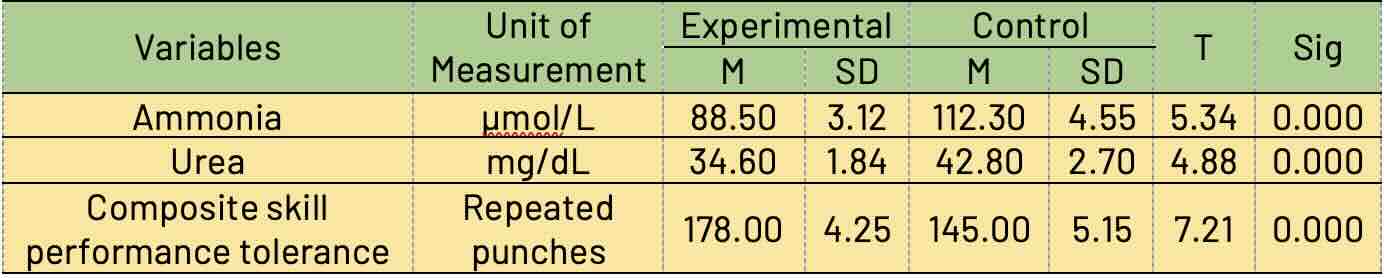
The aim of this study was to investigate the impact of using the metered anaerobic ability training to reduce the indices of metabolic stress and to develop the boxer's ability to withstand the complex skill performance. The experimental group joined an anaerobic training program for (8) weeks, 3 units per week. The measurements were based on biochemical analyses of blood collected immediately after the exertion, and a standardised skill test measuring the boxer's capacity to launch continuous compound punches on the boxing bag for three rounds. The statistical treatments showed unreserved moral superiority for the experimental group. A significant and statistically significant decrease in the rates of accumulation of ammonia and urea in the blood serum after exertion was recorded, in parallel with a high development in the number of repetitions of the correct skill performance under the pressure of extreme fatigue. These results show that anaerobic strength training induces deep physiological adaptations that delay central fatigue and protect muscles from breakdown, ensuring that the boxer maintains neuromuscular coordination and high accuracy in directing compound punches until the final seconds of the fight.
References
Al Behadili, H. J. H., & Kasim, M. A. (2022). The Implications For Learning Of Transferring On Passing Skills In Junior Football Players. JournalNX, 8(9), 39-49.
Alotaibi, N. M. (2017). Online news: A study of ‘credibility’in the context of the Saudi news media (Doctoral dissertation, University of Sussex).
Bompa, T. O., & Buzzichelli, C. (2019). Periodization-: theory and methodology of training. Human kinetics.
Burkett, B. (2025). Applied sport mechanics. Human kinetics.
de Lorenzo, A., & Mihic, N. (2025). Hyperammonemia in athletes: toxic effects and implications for performance. ARCHIVOS DE MEDICINA DEL DEPORTE, 41(5), 233-239.
Duyan, M., Günel, İ., Özoğlu, F., Reyhan, S., Çelik, T., Ok, G., ... & Giuriato, M. (2026). Mental performance skills and athletic performance in combat athletes: the mediating role of mental toughness. Frontiers in Psychology, 17, 1848217.
Finlay, M. J., Greig, M., Page, R. M., & Bridge, C. A. (2023). Acute physiological, endocrine, biochemical and performance responses associated with amateur boxing: A systematic review with meta-analysis. European journal of sport science, 23(5), 774-788.
Holeček, M. (2022). Muscle amino acid and adenine nucleotide metabolism during exercise and in liver cirrhosis: Speculations on how to reduce the harmful effects of ammonia. Metabolites, 12(10), 971.
Ilhomovich, I. A. (2022). Boxing training technology based on the level of physical development of children. ASEAN Journal of Physical Education and Sport Science, 1(1), 1-8.
Kasim, M. A. (2022). Effects of together learning on university students to achievement motivation. JournalNX, 8(05), 57-65.
Kenney, W. L., Wilmore, J. H., & Costill, D. L. (2022). Physiology of sport and exercise. Human kinetics.
Korzeniewski, B. (2026). The effect of AMP deamination on skeletal muscle is stronger and more beneficial in extremely intense exercises to exhaustion and/or extremely stressing conditions. European Journal of Applied Physiology, 126(3), 1825-1844.
Kubiyeva, S., Syzdykov, A., Botagariyev, T., Makunina, O., Mambetov, N., & Aralbayev, A. (2025). Improving the functional status of young boxers in the preparatory period of training with biofeedback. Scientific Reports, 15(1), 39812.
MacLaren, D., & Morton, J. (2024). Biochemistry for sport and exercise metabolism. John Wiley & Sons.
MacLaren, D., & Morton, J. (2024). Biochemistry for sport and exercise metabolism. John Wiley & Sons.
Muñoz-López, M., Quesada-Fernández, G., Sancho-Haro, E. S., Ramírez de la piscina-Viúdez, X., Baz-Valle, E., López-Gil, J. F., & Tornero-Aguilera, J. F. (2026). From Routine Blood Tests to Metabolomics: A Contextual Framework for Interpreting Biomarkers of Training Load, Recovery, and Metabolic Stress in Athletes. Metabolites, 16(7), 483.
Salih, M. M. M., Hashim, R. S., & Kasim, M. A. (2021). Forecasting achievement sports through cooperative learning in handball training in physical education. Annals of Applied Sport Science, 9(3), 0-0.
Susanto, H., Firdaus, S. D. R. A., Sholeh, M., Sugiharto, S., & Pranoto, A. (2026). The Role of Exercise in Cardiovascular Metabolism and Its Importance for Adolescent Metabolic Health. In Enhancing Adolescent Health: The Contribution of Exercise to Growth and Metabolism (pp. 367-392). Singapore: Springer Nature Singapore.
Teixeira, J. E., Forte, P., Neiva, H. P., & Ferraz, R. (2022). The efficiency and transversality of traditional boxing skills to several full-contact combat sports: a narrative review.
Tian, T., Niu, Y., & Bao, S. (2026). The effects of 4 weeks of sport-specific repeated sprint training on upper-body strength quality, anaerobic capacity and punching ability of elite male boxers. Frontiers in Sports and Active Living, 8, 1839505.
Tornero-Aguilera, J. F., Jimenez-Morcillo, J., Rubio-Zarapuz, A., & Clemente-Suárez, V. J. (2022). Central and peripheral fatigue in physical exercise explained: a narrative review. International journal of environmental research and public health, 19(7), 3909.
Tortu, E., Ouergui, I., Ulupinar, S., Özbay, S., Gençoğlu, C., & Ardigò, L. P. (2024). The contribution of energy systems during 30-second lower body Wingate anaerobic test in combat sports athletes: Intermittent versus single forms and gender comparison. PloS one, 19(5), e0303888.
Tshibangu, A. M. N. (2023). Boxing Practitioners Physiology Review: 2. Systemic Responses and Adaptations. Open Journal of Molecular and Integrative Physiology, 13(1), 1-67.
Tshibangu, A. M. N. (2025). Boxing Practitioners Physiology Review: 4. Faith, Life Expectancy, Gender, and Childhood.
Wang, X., Soh, K. G., Samsudin, S., Deng, N., Liu, X., Zhao, Y., & Akbar, S. (2023). Effects of high-intensity functional training on physical fitness and sport-specific performance among the athletes: A systematic review with meta-analysis. Plos one, 18(12), e0295531.
Xu, Q., Fei, J., Mao, R., Liu, L., & Fei, C. (2025). Effects of BFR-RST on upper limb performance in boxers: a study based on physiological indices, anthropometric measurement indices, anaerobic power, and punching performance. Frontiers in Physiology, 16, 1453153.
Downloads
Published
Issue
Section
License
Copyright (c) 2026 Haider Mohammed Jassim Al-Khaikani (Author)

This work is licensed under a Creative Commons Attribution-ShareAlike 4.0 International License.