Mental Health Prediction System Using Machine Learning Algorithms
DOI:
https://doi.org/10.66968/1gjr3104Keywords:
Accuracy, Logistic Regression, Decision Tree, Naive Bayes, Random ForestAbstract
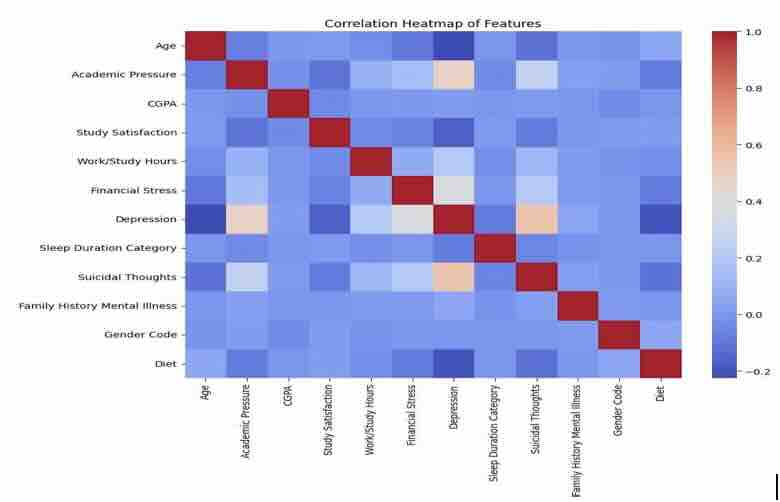
This technical report explains how a machine learning-based system was developed and tested to identify the risks of depression in students of a university. This research report is an answer to the demand of the proactive and easy-to-use screening tools in cases of an increasing global mental health crisis in the academic environment. The system was built on a large volume of data, 27,889 student records in total, and studied 18 major characteristics of students in terms of demographics, academic success, and mental health factors. It used a systematic 6 stage methodology that included data preprocessing, model training and performance validation. Four monitored machine learning algorithms were put into version and juxtaposed: Logistic Regression, Decision Tree, Naive Bayes, and Random Forest. The findings indicated that the Logistic Regression was the most accurate with an accuracy of 84.38 and it was higher than the other models. The main results of the analysis included that the prevalence of depression (58.5% and suicidal thoughts (63.3% are high in the sample population and indicate the severity of the issue. Suicidal Thoughts and Academic Pressure were the most important risk factors mentioned by the model with the feature importance scores of 23.2% and 17.1, respectively. The research report is able to prove the technical feasibility and clinical utility of an automated and accessible and privacy-aware screening tool. This system is not a replacement of a professional diagnosis, but it offers a helpful initial step toward recognizing at-risk students, assessing them in due time and offering the necessary assistance, and leading to more sophisticated institutional mental health approaches.
References
Chung, Jetli, and Jason Teo. "Mental health prediction using machine learning: taxonomy, applications, and challenges." Applied Computational Intelligence and Soft Computing 2022.1 (2022): 9970363.
Chung, Jetli, and Jason Teo. "Mental health prediction using machine learning: taxonomy, applications, and challenges." Applied Computational Intelligence and Soft Computing 2022.1 (2022): 9970363.
Fu, You, Fang Ren, and Jiantao Lin. "Apriori algorithm based prediction of students’ mental health risks in the context of artificial intelligence." Frontiers in Public Health 13 (2025): 1533934.
Gurjar, Satvik, et al. "Mental health prediction using machine learning." International Research Journal of Engineering and Technology (IRJET) e-ISSN (2022): 2395-0056.
Kumar, P., and Mithun Dineshkumar. "Prediction Of Mental Health in Working People Using Machine Learning Algorithms." 2025 International Conference on Intelligent and Innovative Technologies in Computing, Electrical and Electronics (IITCEE). IEEE, 2025.
Omiyefa, Seye. "Artificial intelligence and machine learning in precision mental health diagnostics and predictive treatment models." Int J Res Publ Rev 6.3 (2025): 85-99.
Sharma, Sunil Kumar, et al. "Early detection of mental health disorders using machine learning models using behavioral and voice data analysis." Scientific Reports 15.1 (2025): 16518.
Srividya, M., Subramaniam Mohanavalli, and Natarajan Bhalaji. "Behavioral modeling for mental health using machine learning algorithms." Journal of medical systems 42.5 (2018): 88.
Sumathi, M. R., and B. Poorna. "Prediction of mental health problems among children using machine learning techniques." International Journal of Advanced Computer Science and Applications 7.1 (2016).
Vaishnavi, Konda, et al. "Predicting mental health illness using machine learning algorithms." Journal of Physics: Conference Series. Vol. 2161. No. 1. IOP Publishing, 2022.
Downloads
Published
Issue
Section
License
Copyright (c) 2026 Mustafa Ahmed Abdulwahhab (Author)

This work is licensed under a Creative Commons Attribution-ShareAlike 4.0 International License.