Anthropometric and Physical Determinants as Predictors of Playing Position in Youth Football Players
DOI:
https://doi.org/10.66968/28d76p56Keywords:
Anthropometric and Physical Determinants, Predictors of Playing Position, Youth Football PlayersAbstract
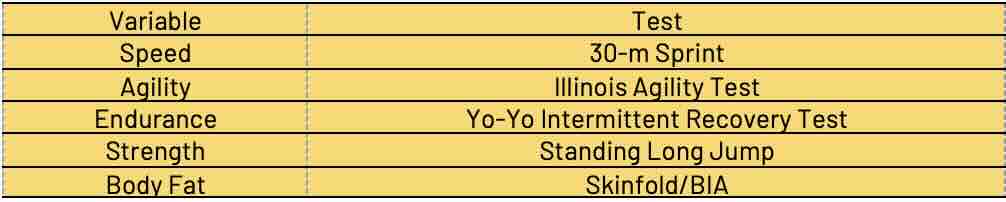
This study aims to investigate the relationship between anthropometric and physical characteristics and the possibility of using them as a tool to predict suitable playing positions for youth soccer players. The study used a predictive correlation design involving aging young football players. Anthropometric variables (height, body mass, body mass index, and body fat percentage) and physical performance variables (speed, agility, muscle strength, and endurance) were collected to predict the most suitable playing position. This study relies on the analysis of characteristics such as height, weight, body fat percentage, muscle strength, speed, and endurance, and the extent to which they relate to the requirements of different playing positions on the field. The results show a clear relationship between certain physical characteristics and playing positions. Goalkeepers and defenders require different anthropometric characteristics compared to midfielders and forwards. The results of the study show that most of the players are in the medium category based on the empirical norms developed. Correlation analysis showed a very strong positive relationship between height and body weight (r = 0.984), BMI (r = 0.932), and body fat percentage (r = 0.961). In contrast, height was negatively correlated with sprint ability (r = −0.407) and agility (r = −0.964), indicating a tendency that increased body size was followed by a decrease in acceleration ability and a change of direction. The resulting empirical norms are able to group the physical characteristics of players into five performance categories so as to provide an objective reference in the placement of player positions. The conclusion states that anthropometric characteristics and physical conditions provide meaningful information in the preparation of the position of young football players.
References
Abate Daga, F., Allois, R., Abate Daga, M., Veglio, F., & Agostino, S. (2024). Coaches’ Subjective Perceptions and Physical Performance: Key Factors in Youth Football Talent Identification—An Exploratory Study. Education Sciences, 14(12). https://doi.org/10.3390/educsci14121400
Aguilera, C. J., Fernando, ;, Rodríguez, R., María, ;, Torrealba Vieira, I., José, ;, Serrano, C., Natalia, ;, Leiva, G., Holway, F., & Jorquera, A. C. ; (2013). Características Antropométricas de Futbolistas Profesionales Chilenos Anthropometric Characteristics of Chilean Professional Football Players. In Int. J. Morphol (Vol. 31, Number 2).
Beato, M., Youngs, A., & Costin, A. J. (2024). The Analysis of Physical Performance During Official Competitions in Professional English Football: Do Positions, Game Locations, and Results Influence Players’ Game Demands? The Journal of Strength & Conditioning Research, 38(5). https://journals.lww.com/nsca-jscr/fulltext/2024/05000/the_analysis_of_physical_performance_during.27.aspx
Kelly, A., Wilson, M. R., Jackson, D. T., & Williams, C. A. (2020). Technical testing and match analysis statistics as part of the talent development process in an English football academy. International Journal of Performance Analysis in Sport, 20(6), 1035–1051. https://doi.org/10.1080/24748668.2020.1824865
Lesinski, M., Prieske, O., Helm, N., & Granacher, U. (2017). Effects of Soccer Training on Anthropometry, Body Composition, and Physical Fitness during a Soccer Season in Female Elite Young Athletes: A Prospective Cohort Study. Frontiers in Physiology, Volume 8-2017. https://www.frontiersin.org/journals/physiology/articles/10.3389/fphys.2017.01093
Michailidis, Y., Stafylidis, A., Vardakis, L., Kyranoudis, A. E., Mittas, V., Leftheroudis, V., Plakias, S., Mandroukas, A., & Metaxas, T. I. (2025). The Running Performance of Elite Youth Football Players in Matches with a 1-4-3-3 Formation in Relation to Their Playing Position. Applied Sciences (Switzerland), 15(7). https://doi.org/10.3390/app15073984
Rosales, R. C., Castillo-Rodriguez, A., Sánchez-Abselam, O., & Tomás González-Fernández, F. (2026). Exploring differences in body composition and physical fitness between U11 and U12 soccer players: Implications for health promotion and athletic performance. SPORT TK-EuroAmerican, 15(2), 1–15. https://revistas.um.es/sportk
Samolis, V., Stafylidis, A., Vlachakis, P., Trampas, A., Karampelas, D., & Michailidis, Y. (2025). The Running Performance of Elite Under-19 Football Players in Matches with a 1-4-2-3-1 Formation in Relation to Their Playing Position. Applied Sciences (Switzerland), 15(13). https://doi.org/10.3390/app15136961
Villaseca-Vicuña, R., Jesam-Sarquis, F., Mardones, C., Moreno, C., & Pérez-Contreras, J. (2021). Comparison of physical fitness and anthropometric profiles among Chilean female national football teams from U17 to senior categories. Journal of Physical Education and Sport, 21, 3218–3226. https://doi.org/10.7752/jpes.2021.s6440
Villaseca-Vicuña, R., Molina-Sotomayor, E., Zabaloy, S., & Gonzalez-Jurado, J. A. (2021). Anthropometric profile and physical fitness performance comparison by game position in the Chile women’s senior national football team. Applied Sciences (Switzerland), 11(5), 1–16. https://doi.org/10.3390/app11052004
Woods, C. T., Raynor, A. J., Bruce, L., McDonald, Z., & Robertson, S. (2016). The application of a multi-dimensional assessment approach to talent identification in Australian football. Journal of Sports Sciences, 34(14), 1340–1345. https://doi.org/10.1080/02640414.2016.1142668
Downloads
Published
Issue
Section
License
Copyright (c) 2026 Mohammed Farhan Khalbas (Author)

This work is licensed under a Creative Commons Attribution-ShareAlike 4.0 International License.