Psychological Stress and Its Relationship with Job Satisfaction among Physical Education Teachers in the Cities of Samarra and Tikrit
DOI:
https://doi.org/10.66968/rewywm05Keywords:
Psychological Stress, Job Satisfaction, Physical Education Teachers, Samarra, TikritAbstract
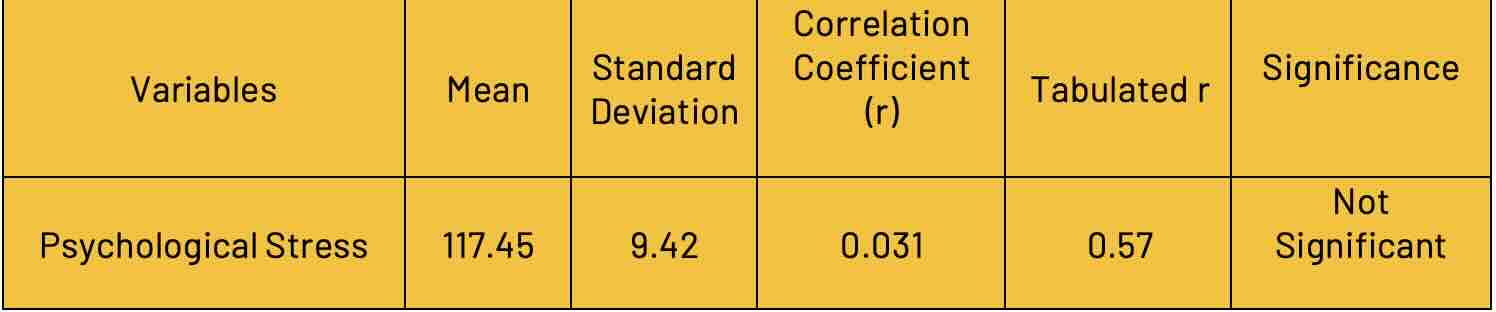
In this study, an effort has been made to investigate the relationship between psychological stress and job satisfaction among physical education teachers in the cities of Samarra and Tikrit. Moreover, an attempt was made to measure the psychological stress level of the physical education teachers. A descriptive research design was used in which survey and correlation research methods were used because of their relevance to the research objectives. Physical education teachers working in the intermediate, secondary, and preparatory schools of Samarra and Tikrit were identified as the research population while a sample of 11 teachers was chosen randomly from them. The data collection tools included psychological stress and job satisfaction scales. Arithmetic means, standard deviation, and Pearson correlation were computed using statistical calculations. From these calculations, it could be concluded that there is no significant relationship between psychological stress and job satisfaction among the studied subjects. Moreover, it can be observed that different amounts of psychological stress exist among physical education teachers. On the basis of the obtained results, it can be concluded that the improvement in the working environment of the physical education teachers should be given consideration.
References
Abu Allam, G. (1973). Psychological stress and its relationship to academic achievement (Unpublished master's thesis). Naif Arab University for Security Sciences, College of Graduate Studies, Department of Social Sciences.
Agarwal, P., Tagde, P., Shah, M., Hawelikar, M., Kaur, G., Gupta, G. K., & Pinjarkar, L. (2024). Navigating the Mind: Analysis of Stress and Mental Well-being. 2024 International Conference on Innovations and Challenges in Emerging Technologies (ICICET), 1–6. https://doi.org/10.1109/ICICET59348.2024.10616359
Aggarwal, R., & Ranganathan, P. (2019). Study designs: Part 2 - Descriptive studies. In Perspectives in Clinical Research (Vol. 10, Number 1, pp. 34–36). Wolters Kluwer Medknow Publications. https://doi.org/10.4103/picr.PICR_154_18
Al-Adaili, A. A. (1995). Human and organizational behavior. Riyadh, Saudi Arabia: Institute of Public Administration.
Al-Hayali, M. A. A. (2010). Psychological stress and its relationship with organizational deviations among physical education teachers (Unpublished master's thesis). College of Physical Education, University of Mosul, Iraq.
Al-Kurdi, I. (1996). Job satisfaction among employees working in sports activities at public and private Jordanian universities. Dirasat: Educational Sciences, 23(2).
Al-Otaibi, A. G. (1995). Job satisfaction among public and private sector employees in the State of Kuwait. Public Administration Journal, 30(4).
Al-Rashoudi, M. A. (1997). Self-concept and its relationship to job satisfaction in security agencies (Unpublished master's thesis). Naif Arab Academy for Security Sciences, Riyadh, Saudi Arabia.
Askar, A., & Abbas, A. A. (1988). The extent of employees’ exposure to work stress in selected social professions. Journal of Social Sciences, 6(1).
Badran, A. H. A. (2006). Job satisfaction and effective leadership. Alam Al-Saudiya Magazine, (4), Riyadh, Saudi Arabia.
Eirín-Nemiña, R., Sanmiguel-Rodríguez, A., & Rodríguez-Rodríguez, J. (2022). Professional satisfaction of physical education teachers. Sport, Education and Society, 27(1), 85–98. https://doi.org/10.1080/13573322.2020.1816540
Elkis-Abuhoff, D. (2026). Quantitative Investigations. In The Wiley Handbook of Art Therapy (pp. 706–713). https://doi.org/https://doi.org/10.1002/9781394215027.ch76
Faiq, F. A. (1996). Occupational work stress. Economic Horizons Journal, 17, 67–68.
Ferguson, K., James, Y., & Bourgeault, I. (2022). Teacher Mental Health and Leaves of Absences: A Pilot Study Examining Gender and Care. Canadian Journal of Education / Revue Canadienne de l’éducation, 45(2), 315–349. www.cje-rce.ca
Han, M. T. (2026). The regulatory role of physical activity in the indirect effect of mental workload on psychological well-being mediated by occupational stress in physical education and sports teachers. BMC Public Health, 26(1). https://doi.org/10.1186/s12889-026-27232-4
Kazimierza Wielkiego, U. (2014). An Inside Look at Teacher Stress: Is Teaching (Un)stressful? HETEROGLOSSIA, 1(2), 143–164. www.wsg.byd.pl
Kuwato, M., & Hirano, Y. (2020). Sense of coherence, occupational stressors, and mental health among Japanese high school teachers in Nagasaki prefecture: A multiple regression analysis. BMC Public Health, 20(1). https://doi.org/10.1186/s12889-020-09475-x
Lu, S., Wei, F., & Li, G. (2021). The evolution of the concept of stress and the framework of the stress system. In Cell Stress (Vol. 5, Number 6, pp. 76–85). Shared Science Publishers OG. https://doi.org/10.15698/CST2021.06.250
Maphal, M. C. (2014). The manifestation of occupational stress in the teaching profession: The unheeded voices of teachers. Mediterranean Journal of Social Sciences, 5(1), 77–88. https://doi.org/10.5901/mjss.2014.v5n1p77
Palmer, C. J., Connor, C., Newton, B. J., Patterson, P., & Birchwood, M. (2017). Early intervention and identification strategies for young people at risk of developing mental health issues: working in partnership with schools in Birmingham, UK. Early Intervention in Psychiatry, 11(6), 471–479. https://doi.org/https://doi.org/10.1111/eip.12264
Rees, W. L. (1976). Stress, distress and disease. British Journal of Psychiatry, 12, 318.
von Haaren-Mack, B., Schaefer, A., Pels, F., & Kleinert, J. (2020). Stress in Physical Education Teachers: A Systematic Review of Sources, Consequences, and Moderators of Stress. Research Quarterly for Exercise and Sport, 91(2), 279–297. https://doi.org/10.1080/02701367.2019.1662878
Woods, S., Sebastian, J., Herman, K. C., Huang, F. L., Reinke, W. M., & Thompson, A. M. (2023). The relationship between teacher stress and job satisfaction as moderated by coping. Psychology in the Schools, 60(7), 2237–2256. https://doi.org/https://doi.org/10.1002/pits.22857
Worthman, C. M. (2015). Chapter 32 - Evolutionary Biology of Human Stress. In M. P. Muehlenbein (Ed.), Basics in Human Evolution (pp. 441–453). Academic Press. https://doi.org/https://doi.org/10.1016/B978-0-12-802652-6.00032-3
Zhang, X., Zhang, Z., Huang, S., Gao, W., Yang, K., Han, Y., & Jeong, H. C. (2026a). The Relationship Between Job Stress and Job Satisfaction of Primary and Secondary School Physical Education Teachers: A Moderated Mediation Model. Behavioral Sciences, 16(5). https://doi.org/10.3390/bs16050737
Zhang, X., Zhang, Z., Huang, S., Gao, W., Yang, K., Han, Y., & Jeong, H. C. (2026b). The Relationship Between Job Stress and Job Satisfaction of Primary and Secondary School Physical Education Teachers: A Moderated Mediation Model. Behavioral Sciences, 16(5). https://doi.org/10.3390/bs16050737
Downloads
Published
Issue
Section
License
Copyright (c) 2026 Mohammed Rashid Mohammed (Author)

This work is licensed under a Creative Commons Attribution-ShareAlike 4.0 International License.