The Effectiveness of Cooperative Learning Compared to Traditional Methods in the Acquisition of Floor Gymnastics Skills Among Second Year Students Al-Nusoor University Faculty of Physical Education and Sports Sciences
DOI:
https://doi.org/10.66968/vxr47e60Keywords:
Cooperative learning, Traditional methods, Floor gymnastics, Motor skillsAbstract
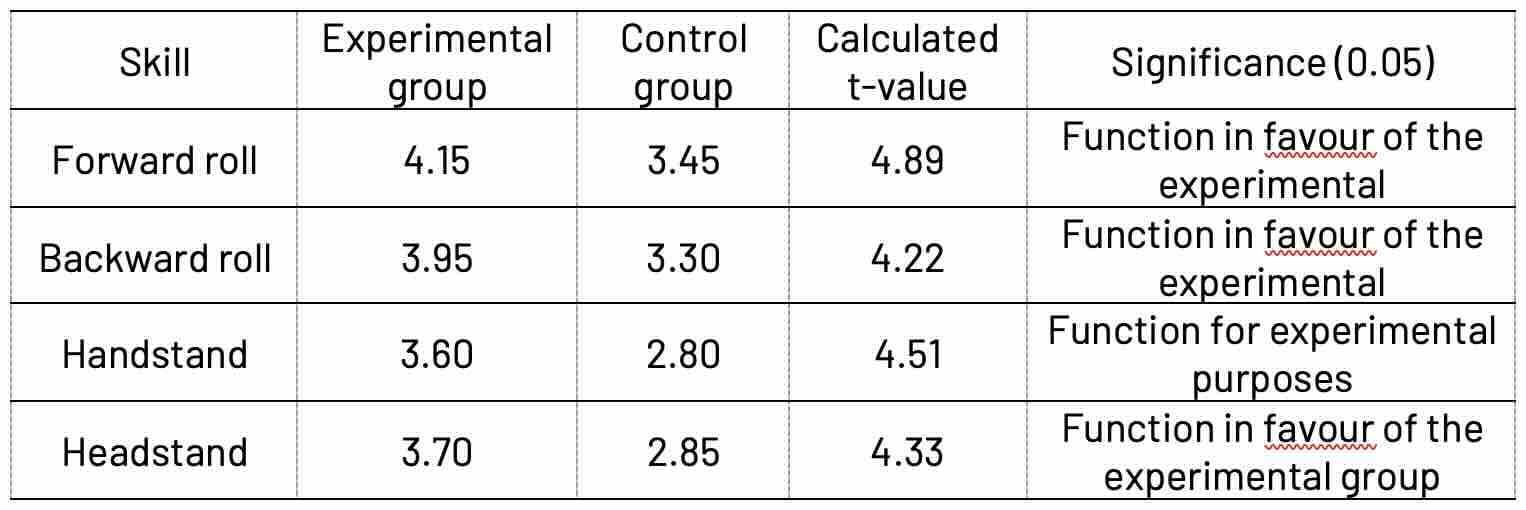
The purpose of the study was to determine the influence of cooperative learning methods and traditional methods on the mastery of floor gymnastics skills (front bolster, back bolster, handstand, headstand) in second-year students, and to compare the effectiveness of the two methods. Experimental research with a two-group design (experiment and control) using pre-test and post-test. The sample totaled 40 students, divided into experimental (n=20, cooperative method) and control (n=20, traditional method) groups, for 8 weeks (16 sessions). Data were analyzed by paired t-tests and independent t-tests via SPSS. The results of the study The experimental group showed a significant improvement in all four skills (front bolster: 2.40 to 4.15, t=8.32; rear bolster: 2.25 to 3.95, t=7.84; handstand: 1.90 to 3.60, t=7.10; headstand: 1.85 to 3.70, t=7.45). The control group also increased significantly but was lower (front roll: 2.35 to 3.45, t=5.17; rear roll: 2.20 to 3.30, t=4.93; handstand: 1.88 to 2.80, t=4.45; headstand: 1.80 to 2.85, t=4.62). At the post-test, the experimental group had a significant advantage over the controls on all skills (t ranged from 4.22–4.89; p<0.05). In conclusion, cooperative learning methods are more effective than traditional methods in improving the mastery of floor gymnastics skills of second-level students, so it is recommended as a methodological alternative to teaching.
References
Abramczyk, A., & Jurkowski, S. (2020). Cooperative learning as an evidence-based teaching strategy: what teachers know, believe, and how they use it. Journal of Education for Teaching, 46(3), 296–308. https://doi.org/10.1080/02607476.2020.1733402
Aksoy, G. K., & Gürsel, F. (2017). The implementation of personal and social resposibility model in physical education classes: An action research. Egitim ve Bilim, 42(191), 415–431. https://doi.org/10.15390/EB.2017.7149
Al-Alawi, Muhammad Hassan and Ratib, Osama Kamel, Scientific Research in Physical Education and Sports Psychology, Dar al-Fikr al-Arabi, Cairo, 1999, p. 210.
Al-Alawi, Muhammad Hassan, The Psychology of Training and Sports Competition, Dar Al-Fikr Al-Arabi for Printing and Publishing, Cairo, 2001, pp. 47, 63, 77, 91, 182.
Al-Mousawi, Najm Abdullah Gali, and Al-Shawi, Ali Abdulaziz, The Concept of Active Learning Strategies between Constructivist and Cognitive Theory, Dar Safaa for Publishing and Distribution, Amman, 2020, p. 145.
Al-Rabie, Mahmoud Daoud and Hamdamin, Saeed Saleh, Methods and Techniques of Physical Education Teaching, Dar Al-Kitab Al-Hadith, Cairo, 2011, pp. 203, 217, 228, 245, 253, 261.
Dudley, D. A. (2025). Educating Character Through Quality Physical Education: A Pedagogical Model. Quest, 77(3), 449–466. https://doi.org/10.1080/00336297.2025.2473423
Dyson, B., & Casey, A., Cooperative Learning in Physical Education and Physical Activity: A Practical Introduction, Routledge, London, 2016, p. 45.
Eshiev, A., Zhutanova, G., Slivkina, N., Akmatov, O., Sarytaeva, M., Zhakupova, G., Kovylina, R., Vorozheikin, A., Bakayev, V., Loginov, D., Usenok, S., Turkova, V., Adusheva, T., & Romanova, E. (2024). Developmental features of coordination skills in young gymnasts with different types of autonomic nervous regulation. Journal of Physical Education and Sport, 24(12), 2077–2083. https://doi.org/10.7752/jpes.2024.12306
Hammad, Mufti Ibrahim, Educational Gymnastics for Men and Women, Al-Kitab Publishing Centre, Cairo, 2000, p. 78.
Hammad, Mufti Ibrahim, Modern Sports Training: Planning, Implementation and Leadership, Dar al-Fikr al-Arabi, Cairo, 1998, pp. 44, 156, 162.
Han, M. (2015). An empirical study on the application of cooperative learning to English listening classes. English Language Teaching, 8(3), 177–184. https://doi.org/10.5539/elt.v8n3p177
Mar, A., Muyassar, I., & Hambali, B. (2025). Character development through physical education: A systematic literature review. 14. https://revistas.um.es/sportk
Ratib, Osama Kamel, Motor Development: Childhood and Adolescence, Dar al-Fikr al-Arabi, Cairo, 1999, pp. 89, 103, 112, 134, 141.
Ren, Q., & Ma, Z. (2025). Experimental exploration of artificial intelligence and ADAMS simulation technology in the teaching of vertical hoop upward throw in rhythmic gymnastics. PLOS ONE, 20(9 September). https://doi.org/10.1371/journal.pone.0330844
Sibomana, A., Karegeya, C., & Sentongo, J. (2021). Effect of cooperative learning on chemistry students’ achievement in Rwandan day-upper secondary schools. European Journal of Educational Research, 10(4), 2079–2088. https://doi.org/10.12973/EU-JER.10.4.2079
Yang, H., Cheng, G., & Cheng, S. (2026). Advanced utilization of motion decomposition and visualization technology in gymnastics education. Frontiers in Psychology, 17. https://doi.org/10.3389/fpsyg.2026.1794257
Downloads
Published
Issue
Section
License
Copyright (c) 2026 Noor Sabah Farhan (Author)

This work is licensed under a Creative Commons Attribution-ShareAlike 4.0 International License.