Validity and Reliability of A Battery of Combined Tests for Assessing Perceptual-Motor Decision-Making Speed in Football
DOI:
https://doi.org/10.66968/dm5ff096Keywords:
Perceptual-motor speed, Decision-making, Reaction time, Validity, Reliability, Football, Iraqi Premier LeagueAbstract
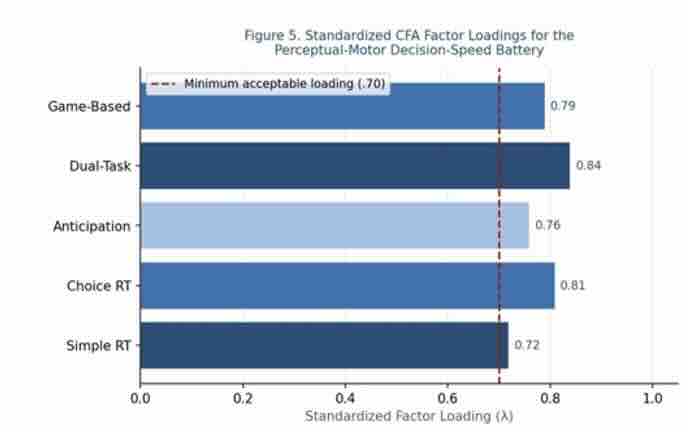
The ability to process visual stimuli and make precise motor decisions within a few milliseconds is an essential component of high-level performance in football. Despite considerable theoretical interest, there is no psychometrically validated test battery available to comprehensively assess perceptual-motor decision-making speed (PMDS) in top Iraqi footballers. Objective: The aim of this study was to develop a test battery comprising five PMDS tests and to determine its content validity, construct validity, criterion-related validity and test-retest reliability among footballers in the Iraqi Premier League. A three-phase sequential mixed-methods design was employed. In Phase 1, content validity was determined by a panel of experts (n = 12) using Lawshe’s content validity ratio (CVR). During phase 2, test-retest reliability was assessed in 30 players during two sessions 72 hours apart using intraclass correlation coefficients (ICC₂,₁), standard error of measurement (SEM) and the minimum detectable change (MDC₉₅). During phase 3, conceptual validity (known groups: elite versus sub-elite, n = 75) and criterion-related validity were assessed using a game performance index (n = 75). The test battery comprised five sequential tests: simple reaction time, choice reaction time, anticipation time, decision-making under dual-task conditions, and a game-based decision-making task. Results, all twelve items assessing content validity exceeded the minimum CVR threshold of 0.83 (range: 0.85–0.96). The ICC values ranged from 0.89 to 0.94, indicating excellent test-retest reliability. The SEM values ranged from 12.4 to 21.3 ms. Elite players achieved significantly faster PMDS scores than non-elite players in all five tests (p < 0.001, d = 0.84–1.12). The total score of the test battery was significantly correlated with the match performance index (r = −0.68, p < 0.001). Confirmatory factor analysis confirmed a unidimensional structure (CFI = 0.96, RMSEA = 0.048). Conclusions, The complete PMDS battery exhibits robust psychometric properties and is suitable for talent identification, performance monitoring and applied research among Iraqi Premier League footballers as well as comparable elite populations.
References
Abernethy, B. (1991). Visual search and decision-making strategies in sport. International Journal of Sport Psychology, 22(3–4), 189–210.
Al-Rawi, Z. S., & Hassan, A. K. (2019). Epidemiology and risk factors of sports injuries among Iraqi footballers: a retrospective cohort study. Iraqi Journal of Medical Sciences, 17(2), 112–121. https://doi.org/10.22578/IJMS.17.2.7
Araújo, D., Roca, A., Memmert, D., & Yarrow, K. (2019). Affordance-based decisions guide defensive actions in sport. Frontiers in Psychology, 10, Article 1477. https://doi.org/10.3389/fpsyg.2019.01477
Bideau, B., Multon, F., Kulpa, R., Fradet, L., Arnaldi, B. and Delamarche, P. (2010). Using virtual reality to analyse sporting performance. IEEE Computer Graphics and Applications, 30(2), 14–21. https://doi.org/10.1109/MCG.2009.134
Cognition, 19(4), 1097–1101. https://doi.org/10.1016/j.concog.2010.01.001
Cohen, J. (1988). Statistical power analysis for the behavioural sciences (2nd ed.). Lawrence Erlbaum Associates.
Ericsson, K. A., & Kintsch, W. (1995). Long-term working memory. Psychological Review, 102(2), 211–245. https://doi.org/10.1037/0033-295X.102.2.211
Ericsson, K. A., & Ward, P. (2007). Capturing the natural superiority of experts in laboratory performance: towards a science of expertise and peak performance. Current Directions in Psychological Science, 16(6), 346–350. https://doi.org/10.1111/j.1467-8721.2007.00533.x
Fajen, B. R., Riley, M. A., & Turvey, M. T. (2009). Information, affordances and action control in sport. International Journal of Sport Psychology, 40(1), 79–107.
Farrow, D., & Abernethy, B. (2003). Do experience and the degree of perception-action coupling influence natural anticipation performance? Perception, 32(9), 1127–1139. https://doi.org/10.1068/p3323
Faul, F., Erdfelder, E., Lang, A. G. and Buchner, A. (2007). G*Power 3: a flexible statistical power analysis programme for the social, behavioural and biomedical sciences. Behavior Research Methods, 39(2), 175–191. https://doi.org/10.3758/BF03193146
Gibson, J. J. (1979). The ecological approach to visual perception. Houghton Mifflin.
Hopkins, W. G. (2000). Measures of reliability in medicine and sports science. Sports Medicine, 30(1), 1–
https://doi.org/10.1016/j.jcm.2016.02.012
https://doi.org/10.1111/j.1744-6570.1975.tb01393.x
Kahneman, D. (2011). Thinking, Fast and Slow. Farrar, Straus and Giroux.
Koo, T. K., & Mae, M. Y. (2016). A guide to the selection and presentation of intraclass correlation coefficients in reliability research. Journal of Chiropractic Medicine, 15(2), 155–163.
Lawshe, C. H. (1975). A quantitative approach to content validity. Personnel Psychology, 28(4), 563–575.
Mann, D. T., Williams, A. M., Ward, P. and Janelle, C. M. (2007). Perceptual-cognitive expertise in sport: a meta-analysis. Journal of Sport and Exercise Psychology, 29(4), 457–478. https://doi.org/10.1123/jsep.29.4.457
Memmert, D. (2010). The gap between inattentional blindness and attentional bias. Consciousness and
Muthén, L. K., & Muthén, B. O. (2017). Mplus User’s Guide (8th ed.). Muthén & Muthén.
Performance, 10(1), 137–142. https://doi.org/10.1123/ijspp.2014-0048
Polit, D. F., & Beck, C. T. (2006). The content validity index: are you sure you know what is being reported? Criticisms and recommendations. Research in Nursing & Health, 29(5), 489–497. https://doi.org/10.1002/nur.20147
Savelsbergh, G. J. P., Williams, A. M., Van der Kamp, J., & Ward, P. (2002). Visual search, anticipation and experience in football goalkeepers. Journal of Sports Sciences, 20(3), 279–287. https://doi.org/10.1080/026404102317284826
SEM. Journal of Strength and Fitness , 19(1), 231–240. https://doi.org/10.1519/15184.1
Streiner, D. L., Norman, G. R. & Cairney, J. (2015). Health measurement scales: a practical guide to their development and application (5th ed.). Oxford University Press.
Vaeyens, R., Lenoir, M., Williams, A. M., Mazyn, L., & Philippaerts, R. M. (2007). The effects of task-related constraints on visual search behaviour and decision-making ability in young footballers. Journal of Sport and Exercise Psychology, 29(2), 147–169. https://doi.org/10.1123/jsep.29.2.147
Vestberg, T., Gustafson, R., Maurex, L., Ingvar, M., & Petrovic, P. (2012). Executive functions predict success among footballers . PLOS ONE, 7(4), Article e34731. https://doi.org/10.1371/journal.pone.0034731
Ward, P., & Williams, A. M. (2003). Development of perceptual and cognitive skills in football: the multidimensional nature of elite performance. Journal of Sport and Exercise Psychology, 25(1), 93–111. https://doi.org/10.1123/jsep.25.1.93
Weir, J. P. (2005). Quantification of test-retest reliability using the intraclass correlation coefficient and the
Williams, A. M. & Reilly, T. (2000). Identification and development of talent in football. Journal of Sport Sciences, 18(9), 657–667. https://doi.org/10.1080/02640410050120041
Williams, A. M., & Burwitz, L. (1993). The use of anticipatory cues in football. In T. Reilly, J. Clarys & A. Stibbe (eds.), Science and football II (pp. 239–244). E & FN Spon.
Williams, A. M., & Ericsson, K. A. (2005). Perceptual-cognitive expertise in sport: some considerations on the application of the expert performance approach. Human Movement Science, 24(3), 283–307. https://doi.org/10.1016/j.humov.2005.06.002
Williams, A. M., Ford, P. R., Eccles, D. W., & Ward, P. (2011). Perceptual-cognitive expertise in sport and its acquisition: implications for applied cognitive psychology. Applied Cognitive Psychology, 25(3), 432–442. https://doi.org/10.1002/acp.1710
Williams, A. M., Ward, P., Knowles, J. M. and Smeeton, N. J. (2004). Anticipatory ability in a real-world task: measurement, training and transfer in tennis. Journal of Experimental Psychology: Applied, 8(4), 259–270. https://doi.org/10.1037/1076-898X.8.4.259
World Medical Association. (2013). World Medical Association Declaration of Helsinki: Ethical principles for medical research involving human subjects. JAMA, 310(20), 2191–2194. https://doi.org/10.1001/jama.2013.281053
Young, W. B., Dawson, B., & Henry, G. J. (2015). Agility and speed of change of direction are independent abilities: implications for assessment and training. International Journal of Sports Physiology and