A Study of The Relationship Between Weakness in The Trunk Stabilising Muscles and Back Injuries Lumbar Injuries Among Boxers in Baghdad Clubs
DOI:
https://doi.org/10.66968/72xncm63Keywords:
Trunk muscle function, Low back pain, Boxers, Baghdad clubs, Muscle stability, Bering-Sørensen test, Visual analogue scaleAbstract
The aim of the study was to investigate the relationship between trunk muscle strength and lower back pain among boxers in Baghdad clubs, by measuring trunk muscle strength, assessing the level of lower back pain in the study sample, and identifying the nature of the correlation between the two variables. The researcher employed a descriptive approach using correlational methods, as this was appropriate to the nature and objectives of the study. The study population consisted of boxers officially registered with clubs in Baghdad and affiliated with the Iraqi Boxing Federation. The research sample was selected using a purposive sampling method and comprised eight boxers aged between 18 and 35 with at least two years’ training experience.
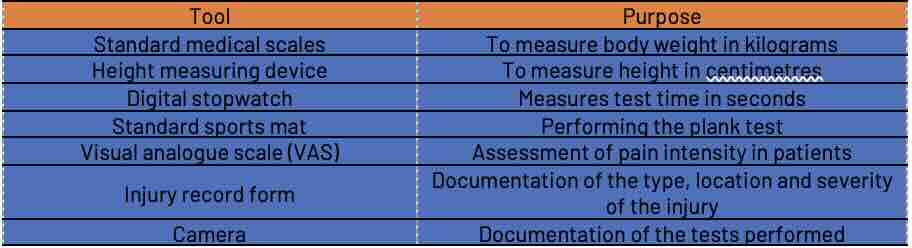
The researcher used a series of physical tests to measure trunk muscle efficiency, namely: the forward trunk stability test, the lateral trunk stability test and the Bering-Sørensen test, as well as the Visual Analogue Scale (VAS) and a specific questionnaire to record low back pain. After collecting and statistically analysing the data using the arithmetic mean, standard deviation, percentage and Pearson’s correlation coefficient, the results showed that 87.5% of the sample had reduced trunk muscle efficiency compared to the levels recommended for athletes. It was also observed that 87.5% of the boxers suffered from lower back pain to varying degrees. The results demonstrated a strong, statistically significant inverse correlation between trunk muscle efficiency and lower back pain, with correlation coefficients ranging from (-0.74) to (-0.85); the Bearing-Sørensen test was the one most strongly associated with lower back pain.
The researcher concluded that reduced trunk muscle function is associated with higher levels of lower back pain in boxers, and that weakness in the erector spinae and lateral trunk muscles may be an important factor associated with the onset of this pain. The researcher recommends the inclusion of core muscle strengthening and stability exercises in boxers’ training programmes, the adoption of core muscle function tests as a means of periodic assessment, as well as the provision of medical supervision and rehabilitation in boxing clubs to reduce lower back pain and improve sporting performance.
References
Abreu-Sosa, S. (2023). Core strengthening. PM&R KnowledgeNow. American Academy of Physical Medicine and Rehabilitation.
Allawi, M. H., & Ratib, O. K. (2017). Scientific research in physical education and sports psychology. Cairo: Dar Al-Fikr Al-Arabi.
Al-Obaidi, A. (2016). Sports injuries and physiotherapy. Baghdad: Dar Al-Kutub Al-Ilmiyah.
Al-Rawi, A. K. (2017). Sports medicine and spinal injuries. Mosul: Dar Ibn Al-Atheer.
Al-Samarra’i, M. (2019). Modern sports training. Baghdad: Dar Al-Hikma.
Biering-Sørensen, F. (1984). Physical measurements as indicators of risk of low back pain over a one-year period. Spine, 9(2), 106–119.
Bliven, K. C. H., & Anderson, B. E. (2013). Trunk stability training for injury prevention. Sports Health, 5(6), 514–522. https://doi.org/10.1177/1941738113481200
Brown, L., Hastings, K., Doyle, G., Bruce-Low, S., & Galbraith, A. (2020). The effects of lower trunk resistance training on backhand punch performance in professional boxers. Journal of Australian Strength and Conditioning, 28(5), 15–24.
De Blaiser, C., Roosen, P., Willems, T., Danneels, L., Vanden Bossche, L., & De Ridder, R. (2018). Is trunk stability a risk factor for lower limb injuries in a population of athletes? A systematic review. Physical Therapy in Sport, 30, 48–56. https://doi.org/10.1016/j.ptsp.2017.08.076
Hassan, A. (2014). Prevention of sports injuries. Baghdad: Dar Al-Rafidain.
McGill, S. M., Childs, A., & Liebenson, C. (1999). Hold times for lumbar stabilisation exercises: clinical targets for assessment and training based on a database of healthy subjects. Archives of Physical Medicine and Rehabilitation, 80(8), 941–944. https://doi.org/10.1016/S0003-9993(99)90087-4
Mohammed, H. (2019). Research methods in physical education and sports science. Cairo: Dar Al-Fikr Al-Arabi.
Smrcina, Z., Woelfel, S., & Burcal, C. (2022). A systematic review of the efficacy of trunk stability exercises in patients with non-specific low back pain. International Journal of Sports Physiotherapy, 17(5), 766–774. https://doi.org/10.26603/001c.37251
Stuber, K. J., Bruno, P., Sajko, S., & Hayden, J. A. (2014). Trunk stability exercises for low back pain in athletes: a systematic review of the literature. Clinical Journal of Sport Medicine, 24(6), 448–456. https://doi.org/10.1097/JSM.0000000000000081