An Assessment of the Behavioural Performance of Youth Football Coaches at Academies in the City of Samarra
DOI:
https://doi.org/10.66968/vg7rf745Keywords:
coaching behaviours, CBAS system, football academies, age-group coaches, behavioural observation, football, coaching environment.Abstract
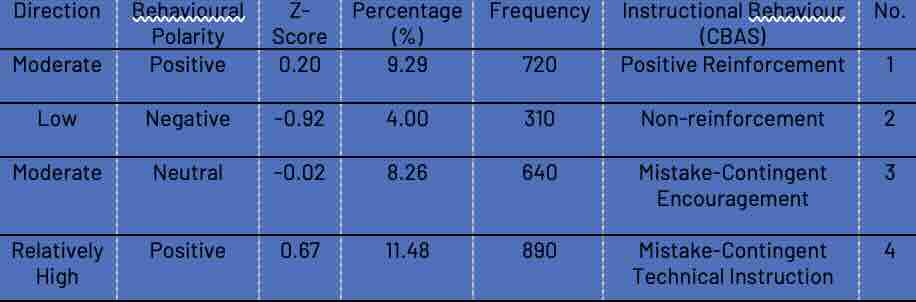
The present study aimed to identify the reality of coaching behaviours among youth football academy coaches in the city of Samarra using the Coaching Behaviour Analysis System (CBAS) developed by Smith et al (1977), as one of the standardised scientific systems for analysing coaching behaviour within sporting environments. The researcher adopted a descriptive approach using structured observation. The research sample consisted of eight coaches working at private football academies in the city of Samarra. Two training sessions were filmed for each coach, totalling 16 training sessions, with each session lasting 40 minutes. The study used three high-resolution digital cameras to document the training sessions, after which the coaching behaviours were analysed according to the behavioural categories adopted in the CBAS system. A 5-second time interval was adopted during the behavioural coding process, after which the data was organised and analysed using frequencies, percentages and Z-scores to identify the polarity and trends of the behaviours. The results also showed that the general technical instructions category recorded the highest frequency of occurrence among training behaviours, followed by the organisation and management category, indicating that trainers focused heavily on technical and organisational aspects during the training sessions. The results also showed a relative increase in positive reinforcement and general encouragement behaviours, compared to a clear decrease in punitive and negative behaviours such as punishment, punitive instructions and ignoring mistakes. The study concluded that the training environment within football academies in the city of Samarra tends towards the use of supportive and positive coaching behaviours rather than negative and punitive ones. The study recommended the need to employ standardised behavioural observation systems in the assessment of coaching performance, as well as the development of training programmes for age-group coaches, thereby contributing to improving the quality of coaching interaction within sports academies.
References
Amorose, A. J., & Horn, T. S. (2000). Intrinsic motivation: Relationships with collegiate athletes’ gender, scholarship status, and perceptions of their coaches’ behaviour. Journal of Sport & Exercise Psychology, 22(1), 63–84. https://doi.org/10.1123/jsep22.1.63
Chelladurai, P. (2007). Leadership in sports: The multidimensional model. Handbook of Sport Psychology, 3, 113–135.
Côté, J., & Gilbert, W. (2009). An integrative definition of coaching effectiveness and expertise. International Journal of Sports Science & Coaching, 4(3), 307–323. https://doi.org/10.1260/174795409789623892
Erickson, K., Cote, J., Hollenstein, T., & Deakin, J. (2011). Examining coach-athlete interactions using systematic observation. International Journal of Sports Science & Coaching, 10(6), 1055–1070. https://doi.org/10.1016/j.psychsport2011.06.006
Hollembeak, J., & Amorose, A.J. (2005). Perceived Coaching Behaviours and College Athletes’ Intrinsic Motivation: A Test of Self-Determination Theory. Journal of Applied Sport Psychology, 17, 20–36. https://doi.org/10.1080/10413200590907540
Horn, T. S. (2008). Coaching effectiveness in the sport domain. Advances in Sport Psychology, 3, 239-267.
Jowett, S. (2017). Coaching effectiveness: the coach-athlete relationship at the centre of nurturing gold medal winners. International Journal of Sports Science & Coaching, 12(2), 154-158. https://doi.org/10.1016/j.copsyc2017.05.006
Mageau, G. A., & Vallerand, R. J. (2003). The coach-athlete relationship: A motivational model. Journal of Sports Sciences, 21(11), 883-904. https://doi.org/10.1080/0264041031000140374
Millard, L. (1996). Differences in coaching behaviours of male and female high school coaches. Perceptual and Motor Skills, 82(1), 139–146. https://doi.org/10.1123/wspaj2022.-0024
Mora, À., Cruz, J., & Torregrosa, M. (2009). Effects of a training programme on the communication styles of basketball coaches. Revista de Psicología del Deporte, 18(Suppl), 299–302.
Myers, N.D., Feltz, D.L., Chase, M.A., Reckase, M.D., & Hancock, G.R. (2008). The Coaching Efficacy Scale II—High School Teams. Educational and Psychological Measurement, 68, 1059–1076.
Rodríguez-Peláez, D., Garrido, P., Conde, C., & Almagro, B. J. (2015). Adaptation and validation of the CBAS for the observation of motivational climates. Cuadernos De Psicología Del Deporte, 15(3), 253–260. Retrieved from https://revistas.um.es/cpd/article/view/244721
Smith, R. E., Smoll, F. L., & Hunt, E. B. (1977). A system for the behavioural assessment of athletic coaches. Research Quarterly, 48(2), 401–407. https://doi.org/10.1080/10671315.1977.10615438
Smith, R.E., Smoll, F.L. (2011). Cognitive–Behavioural Coach Training: A Translational Approach to Theory, Research, and Intervention. In: Luiselli, J., Reed, D. (eds) Behavioural Sport Psychology. Springer, New York, NY. https://doi.org/10.1007/978-1-4614-0070-7_14
Torregrosa, M., Sousa, C., Viladrich, C., Villamarín, F., & Cruz, J. (2008). The motivational climate and coaches’ communication style as predictors of commitment in young footballers. Psicothema, 20(2), 254–259.
Wallhead, T. L., & Ntoumanis, N. (2004). Effects of a sport education intervention on students’ motivational responses. Journal of Teaching in Physical Education, 23(1), 4–18. https://doi.org/10.1123/jtpe23.1.4