Three-Dimensional Biomechanical Analysis of Movement Patterns Associated with Anterior Cruciate Ligament Injuries in Football Players
DOI:
https://doi.org/10.66968/01wptj37Keywords:
Anterior cruciate ligament, Biomechanical analysis, Football, Knee deflection, Three-dimensional motion capture, Injury preventionAbstract
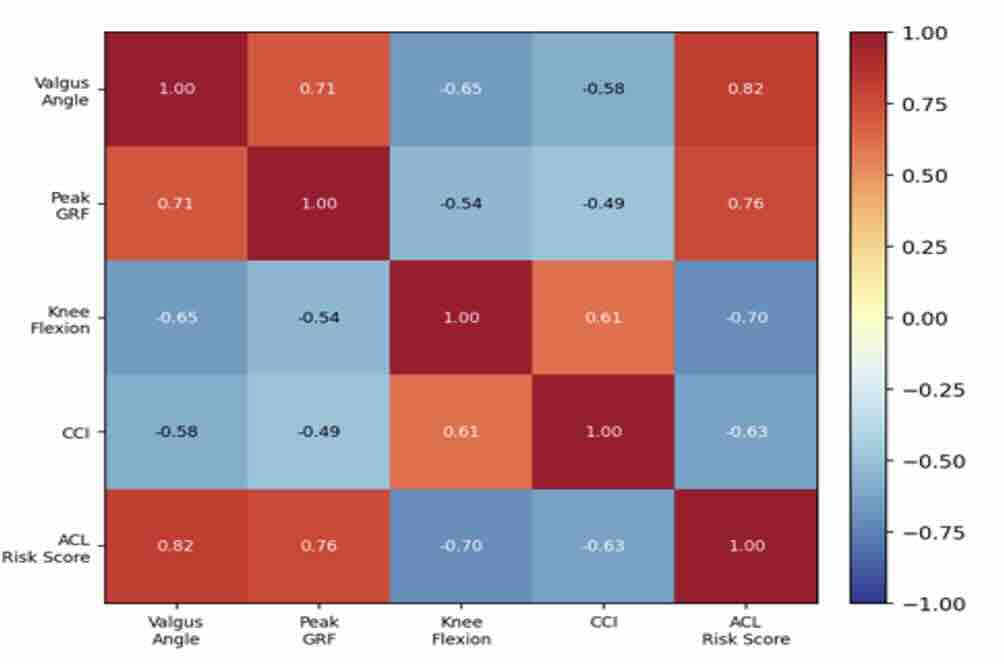
Anterior cruciate ligament (ACL) injuries are common and serious musculoskeletal injuries in football, due to their negative impact on players’ health, the continuity of their sporting careers, and individual and team performance levels. Three-dimensional biomechanical analysis is an objective and accurate tool for identifying movement patterns associated with an increased risk of injury, particularly those that are difficult to observe or assess effectively using traditional two-dimensional analysis methods. The study aimed to determine the three-dimensional kinematic and kinetic characteristics of the lower limbs during the performance of high-risk movement tasks similar to those required in football among players from three clubs in the Iraqi Premier League, as well as to compare biomechanical risk indicators between the clubs and to reveal the relationship between specific movement patterns and the composite risk of anterior cruciate ligament injury. A descriptive, cross-sectional study design was employed. The study sample comprised sixty male football players, with twenty players from each of the Al-Samarra, Al-Alam and Al-Dour clubs. Data were collected using the VICON Nexus 3D motion capture system, comprising 12 cameras at 200 Hz, two Kistler force plates at 1000 Hz, and the Noraxon Ultium system for measuring electromyography (EMG) at 2000 Hz. The players performed three standardised movement tasks: a 45-degree cut on one leg, a two-foot landing after a jump, and a 180-degree turn. The main variables included the maximum internal knee varus angle, peak ground reaction force, lower limb joint flexion angles at the moment of first contact, and the joint muscle contraction index. The results showed statistically significant differences between the clubs in knee varus angle, with an F-value of F(2,57) = 8.34, a significance level of p = 001., and an effect size of η² = .226, as well as in peak ground reaction force (F(2,57) = 6.21, p = 00.3, η² = 179.) and in knee flexion angle (F(2,57) = 7.85, p = 00.1, η² = 216.). The knee varus angle also showed the strongest correlation with the composite risk score for anterior cruciate ligament injury, with a correlation coefficient of r = 82. at a significance level of p < .001. Group analysis revealed two distinct risk profiles: the first was a high-risk biomechanical profile, characterised by a marked increase in knee varus and a reduced knee flexion angle; the second was a low-risk profile, characterised by a better degree of protective co-contraction. IIraqi footballers in the clubs included in the study exhibited biomechanical patterns associated with an increased risk of anterior cruciate ligament injury whilst performing football-specific motor tasks. Differences between clubs suggest that risk indicators may be influenced by multiple factors, including the nature of training programmes, pitch surface characteristics, and the level of strength training and neuromuscular control. The study’s findings underscore the importance of implementing targeted preventive programmes to reduce ACL injuries in Iraqi football clubs.
References
Al-Rawi, Z. S., & Hassan, A. K. (2019). Epidemiology and risk factors of sports injuries among Iraqi football players: A retrospective cohort study. Iraqi Journal of Medical Sciences, 17(2), 112–121. https://doi.org/10.22578/IJMS.17.2.7
Boden, B. B., Dean, J. S., Vigen, J. A., Jr., & Garrett, W. E., Jr. (2000). Mechanisms of anterior cruciate ligament injury. Orthopaedic Surgery, 23(6), 573–578. https://doi.org/10.3928/0147-7447-20000601-15
Cohen, J. (1988). Statistical power analysis for the behavioural sciences (2nd ed.). Lawrence Erlbaum Associates.
Crossley, K. M., Patterson, B. E., Colvinor, A. J., Broder, A. M., Mosley, J. L., & Carlson, J. (2020). Making football safer for women: a systematic review and meta-analysis of injury prevention programmes in 11,773 female footballers. British Journal of Sports Medicine, 54(18), 1089–1098. https://doi.org/10.1136/bjsports-2019-101587
Dempsey, A. R., Lloyd, D. G., Elliott, B. C., Steele, J. R., & Munro, B. J. (2009). Changing the technique of the lateral cut reduces knee loading. American Journal of Sports Medicine, 37(11), 2194–2200. https://doi.org/10.1177/0363546509334667
Faul, F., Erdfelder, E., Lang, A. G., & Buchner, A. (2007). G*Power 3: A flexible statistical power analysis software for the social, behavioural, and biomedical sciences. Behavioural Research Methods, 39(2), 175–191. https://doi.org/10.3758/BF03193146
Giza, E., Mithofer, K., Farrell, L., Zarins, B., & Gill, T. (2005). Injuries in professional women’s football. British Journal of Sports Medicine, 39(4), 212–216. https://doi.org/10.1136/bjsm.2004.011973
Griffin, L. Y., Albohm, M. J., Arendt, E. A., Bahr, R., Beynnon, B. D., DeMaio, M., Dick, R. W., Engebretsen, L., Garrett, W. E., Jr., Hanavin, J. A., Hewitt, T. E., Houston, L. J., Ireland, M. L., Johnson, R. J., Levert, S., Mandelbaum, B. R., Mann, B. J., Marks, B. H., Marshall, S. W., … Yu, B. (2006). Understanding and preventing non-contact anterior cruciate ligament injuries: a review of the Second Hunt Valley Meeting, January 2005. American Journal of Sports Medicine, 34(9), 1512–1532. https://doi.org/10.1177/0363546506286866
Grindem, H., Snyder-Mackler, L., Moksnes, H., Engebretsen, L., & Risberg, M. A. (2016). Simple decision-making rules can reduce the risk of re-injury by 84% after anterior cruciate ligament reconstruction: the Delaware-Oslo Anterior Cruciate Ligament Cohort Study. British Journal of Sports Medicine, 50(13), 804–808. https://doi.org/10.1136/bjsports-2016-096031
Hermens, H. J., Freriks, B., Disselhorst-Klug, C., & Rau, G. (2000). Development of recommendations for SEMG sensors and sensor placement procedures. Journal of Electromyography and Kinesiology, 10(5), 361–374. https://doi.org/10.1016/S1050-6411(00)00027-4
Hewitt, T. E., Meyer, J. D., Ford, K. R., Heidt, R. S., Colosimo, A. J., McLean, S. J., van den Boogert, A. J., Paterno, M. F., & Sukop, B. (2005). Biomechanical measures of neuromuscular control and knee valgus load predict the risk of anterior cruciate ligament injury in female athletes: a prospective study. American Journal of Sports Medicine, 33(4), 492–501. https://doi.org/10.1177/0363546504269591
Hewitt, T. E., Torg, J. S., & Boden, B. B. (2009). Video analysis of trunk and knee motion during non-contact anterior cruciate ligament injury in female athletes: lateral trunk motion and knee abduction are common components of the injury mechanism. British Journal of Sports Medicine, 43(6), 417–422. https://doi.org/10.1136/bjsm.2009.059162
Hewitt, T. E., Zazolak, P. T., Meyer, J. D., & Ford, K. R. (2004). A review of electromyographic activation levels, temporal differences, and increased incidence of anterior cruciate ligament injury in female athletes. British Journal of Sports Medicine, 39(6), 347–350. https://doi.org/10.1136/bjsm.2004.014571
Krosshaug, T., Nakamae, A., Boden, B. P., Engebretsen, L., Smith, G., Slauterbeck, J. R., Hewett, T. E., & Bahr, R. (2007). Mechanisms of anterior cruciate ligament injury in basketball: a video analysis of 39 cases of “ ”. American Journal of Sports Medicine, 35(3), 359–367. https://doi.org/10.1177/0363546506293899
Lynch, A. D., Lux, J., Ax, M. J., & Snyder-McLer, L. (2015). The influence of anterior cruciate ligament status on the diagnosis of athletes performing cutting and pivoting movements. Journal of Orthopaedic and Sports Physical Therapy, 45(9), 653–662. https://doi.org/10.2519/jospt.2015.5930
Maher, S. A., Mohamad, Y. S., & Abdul-Kareem, H. J. (2021). Biomechanical analysis of football players in the Middle East: implications for injury prevention. Journal of Human Movement Science, 78, 89–101. https://doi.org/10.2478/hukin-2021-0049
Mayer, J. D., Sugimoto, D., Thomas, S., & Hewitt, T. E. (2013). The effect of age on the efficacy of neuromuscular training to reduce anterior cruciate ligament injuries in female athletes: a meta-analysis. American Journal of Sports Medicine, 41(1), 203–215. https://doi.org/10.1177/0363546512460637
McLean, S. J., Neill, R. J., Myers, P. T., & Walters, M. R. (2004). Knee joint motion during the lateral cut manoeuvre: injury risk in women. Medicine & Science in Sports & Exercise, 31(7), 959–968. https://doi.org/10.1097/00005768-199907000-00007
Merriaux, P., Dupuis, Y., Boutteau, R., Vasseur, P., & Savatier, X. (2017). A study on the configuration of the Vicon system to improve accuracy. Sensors, 17(7), Article 1591. https://doi.org/10.3390/s17071591
Olsen, O. E., McLeabost, J., Engebretsen, L., & Bar, R. (2004). Mechanisms of anterior cruciate ligament injury in team handball: a systematic video analysis. The American Journal of Sports Medicine, 32(4), 1002–1012. https://doi.org/10.1177/0363546503261724
Sugimoto, D., Myer, G. D., Bush, H. M., Klugman, M. F., Medina McKeon, J. M., & Hewett, T. E. (2016). Adherence to neuromuscular training and reduced risk of anterior cruciate ligament injury in female athletes: a meta-analysis. Journal of Sports Training, 47(6), 714–723. https://doi.org/10.4085/1062-6050-47.6.10
Waldin, M., Haglund, M., Magnusson, H., & Ekstrand, J. (2016). Anterior cruciate ligament injuries in men’s professional football: A 15-year prospective study on temporal trends and return-to-play rates revealed that only 65% of players were still playing at the highest level 3 years after an anterior cruciate ligament tear. British Journal of Sports Medicine, 50(12), 744–750. https://doi.org/10.1136/bjsports-2015-095952
World Medical Association. (2013). The World Medical Association’s Declaration of Helsinki: Ethical Principles for Medical Research Involving Human Subjects. JAMA, 310(20), 2191–2194. https://doi.org/10.1001/jama2013.281053
Wouda, F. J., Giuberti, M., Bellusci, G., Maartens, E., Reenalda, J., van Beijnum, B. J. F., & Veltink, P. H. (2018). Full-body pose estimation using only five inertial sensors: an active or passive learning approach? Sensors, 16(12), Article 2138. https://doi.org/10.3390/s16122138
Zazulak, B. T., Hewett, T. E., Reeves, N. P., Goldberg, B., & Cholewicki, J. (2007). Impaired trunk neuromuscular control predicts the risk of knee injury: a prospective biomechanical-epidemiological study. The American Journal of Sports Medicine, 35(7), 1123–1130. https://doi.org/10.1177/0363546507301585
Zebis, M. K., Andersen, L. L., Bencke, J., Kjaer, M., & Aagaard, P. (2009). Identifying athletes at risk of future anterior cruciate ligament rupture through neuromuscular testing. American Journal of Sports Medicine, 37(10), 1967–1973. https://doi.org/10.1177/0363546509335000