The Impact of Functional Strength Training on Balance Agility and Injury Prevention in Young Athletes
DOI:
https://doi.org/10.66968/qxw0tp22Keywords:
Functional strength training, Dynamic balance, Agility, Injury prevention, Young athletes, Star Excursion Balance Test, Proprioception, Youth sportsAbstract
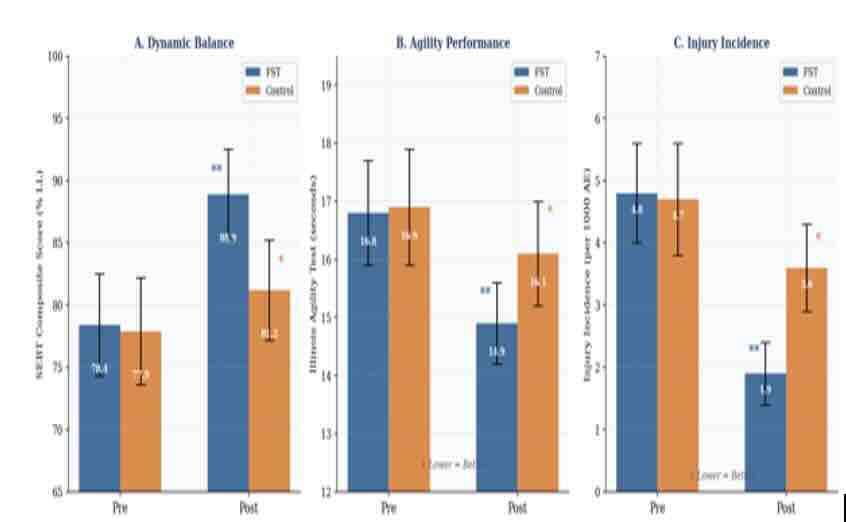
The purpose of this research was to determine how functional strength (FST) training over 12 weeks influenced injured young competitive athletes’ dynamic balance, agility, and incidence of injury. The project used 40 young competitive athletes (mean age = 15.3±1.2 years) as participants and was designed as a randomized controlled trial with 20 in the experimental FST group and 20 in the active control (AC) group. Balance was measured by the Star Excursion Balance Test (SEBT) composite score; agility was measured with the Illinois Agility Test (IAT) time; and the number of injuries suffered per 1000 athlete exposures (AE) was used to determine how each group differed regarding incidence of injury. Other measures included the 1-repetition maximum (1-RM) back squat for lower-body strength, joint position sense (JPS) for proprioceptive acuity, and the composite score of the Functional Movement Screen test (FMS) for quality of movement. Compared to Control an FST condition had much larger impact on SEBT composite scores (Delta 13.4% vs 4.4%: p<.001; d=2.04) and IAT (Delta 11.3% vs 4.7%: p<.001; d=1.58) as well as Injuries (Delta -60.4% vs -23.4%: p<.001; d=1.87). With all between-group effect sizes being considered large, the data strongly supports the use of FST in early phases of injury prevention and performance enhancement for youth athletes.
References
Behm, D. G., & Chaouachi, A. (2011). A review of the acute effects of static and dynamic stretching on performance. European Journal of Applied Physiology, 111(11), 2633–2651. https://doi.org/10.1007/s00421-011-1879-2
Chimera, N. J., Swanik, K. A., Swanik, C. B., & Straub, S. J. (2004). Effects of plyometric training on muscle-activation strategies and performance in female athletes. Journal of Athletic Training, 39(1), 24–31.
Cook, G., Burton, L., & Hoogenboom, B. (2006). Pre-participation screening: The use of fundamental movements as an assessment of function – Part 1. North American Journal of Sports Physical Therapy, 1(2), 62–72.
Emery, C. A., & Meeuwisse, W. H. (2010). The effectiveness of a neuromuscular prevention strategy to reduce injuries in youth soccer. British Journal of Sports Medicine, 44(8), 555–562. https://doi.org/10.1136/bjsm.2010.070771
Faigenbaum, A. D., & Myer, G. D. (2010). Resistance training among young athletes: Safety, efficacy and injury prevention effects. British Journal of Sports Medicine, 44(1), 56–63. https://doi.org/10.1136/bjsm.2009.068098
Faigenbaum, A. D., Lloyd, R. S., MacDonald, J., & Myer, G. D. (2016). Citius, Altius, Fortius: Beneficial effects of resistance training for young athletes. British Journal of Sports Medicine, 50(1), 3–7. https://doi.org/10.1136/bjsports-2015-095560
Fuller, C. W., Ekstrand, J., Junge, A., Andersen, T. E., Bahr, R., Dvorak, J., Hagglund, M., McCrory, P., & Meeuwisse, W. H. (2006). Consensus statement on injury definitions and data collection procedures in studies of football injuries. British Journal of Sports Medicine, 40(3), 193–201. https://doi.org/10.1136/bjsm.2005.025270
Gribble, P. A., Hertel, J., & Plisky, P. (2012). Using the Star Excursion Balance Test to assess dynamic postural-control deficits and outcomes in lower extremity injury. Journal of Athletic Training, 47(3), 339–357. https://doi.org/10.4085/1062-6050-47.3.08
Han, J., Anson, J., Waddington, G., Adams, R., & Liu, Y. (2015). The role of ankle proprioception for balance control in relation to sports performance and injury. BioMed Research International, 2015, 842172. https://doi.org/10.1155/2015/842172
Hewett, T. E., Myer, G. D., Ford, K. R., Heidt, R. S., Colosimo, A. J., McLean, S. G., & Succop, P. (2006). Biomechanical measures of neuromuscular control predict anterior cruciate ligament injury risk in female athletes. American Journal of Sports Medicine, 33(4), 492–501. https://doi.org/10.1177/0363546504269591
Lloyd, R. S., & Oliver, J. L. (2012). The youth physical development model: A new approach to long-term athletic development. Strength & Conditioning Journal, 34(3), 61–72. https://doi.org/10.1519/SSC.0b013e31825760ea
Mandelbaum, B. R., Silvers, H. J., Watanabe, D. S., Knarr, J. F., Thomas, S. D., Griffin, L. Y., & Garrett, W. (2005). Effectiveness of a neuromuscular and proprioceptive training program in preventing anterior cruciate ligament injuries in female athletes. American Journal of Sports Medicine, 33(7), 1003–1010. https://doi.org/10.1177/0363546504272261
Myer, G. D., Jayanthi, N., DiFiori, J. P., Faigenbaum, A. D., Kiefer, A. W., Logerstedt, D., & Micheli, L. J. (2015). Sport specialization, Part I: Does early sports specialization increase negative outcomes? Sports Health, 7(5), 437–442. https://doi.org/10.1177/1941738115598747
Plisky, P. J., Rauh, M. J., Kaminski, T. W., & Underwood, F. B. (2006). Star Excursion Balance Test as a predictor of lower extremity injury in high school basketball players. Journal of Orthopaedic & Sports Physical Therapy, 36(12), 911–919. https://doi.org/10.2519/jospt.2006.2244
Riemann, B. L., & Lephart, S. M. (2002). The sensorimotor system, Part I: The physiologic basis of functional joint stability. Journal of Athletic Training, 37(1), 71–79.
Sheppard, J. M., & Young, W. B. (2006). Agility literature review: Classifications, training and testing. Journal of Sports Sciences, 24(9), 919–932. https://doi.org/10.1080/02640410500457109
Soligard, T., Myklebust, G., Steffen, K., Holme, I., Silvers, H., Bizzini, M., Junge, A., Dvorak, J., Bahr, R., & Andersen, T. E. (2008). Comprehensive warm-up programme to prevent injuries in young female footballers. BMJ, 337, a2469. https://doi.org/10.1136/bmj.a2469