The Effect of the KWL Strategy on the Acquisition of Some Basic Basketball Skills by Students
DOI:
https://doi.org/10.66968/qaqbpe78Keywords:
Teaching Strategies, K.W.L. Strategies, Learning, Basic Basketball SkillsAbstract
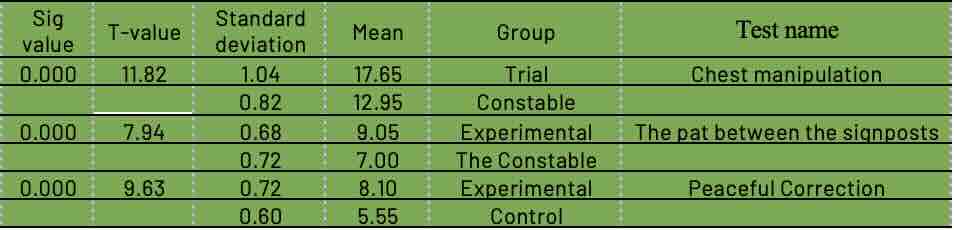
The aim of this study was to investigate the effect of the K.W.L. strategy on cognitive achievement and the learning of some basic basketball skills among secondary school students. The researcher employed an experimental approach using a two-group design (experimental and control groups) with pre- and post-tests. The research population consisted of 120 fourth-year secondary school students at the University Co-educational Secondary School for the academic year 2025–2026. A sample of 40 students was selected at random and divided into two groups of 20 students each. The experimental group adopted the K.W.L. strategy, whilst the control group used the traditional method. The skills tests included: the chest compression test, the defibrillation test, and the first-aid assessment test, with the validity, reliability and objectivity of the tests verified. The main experiment lasted for eight weeks, with one teaching unit per week, incorporating the stages of the (What do I know? What do I want to know? What have I learnt?) within the main section of the lesson. The results showed statistically significant differences between the pre- and post-tests in favour of the post-tests in both groups; however, the improvement was greater in the experimental group. The results also showed that the experimental group outperformed the control group in all the skills under investigation, confirming the effectiveness of the K.W.L. strategy in improving skill learning and cognitive achievement in basketball. The researcher attributes this to the strategy’s role in activating prior knowledge, increasing mental engagement, and enhancing motivation and feedback during learning. The study recommended the need to employ active learning strategies, particularly the K.W.L. strategy, in physical education teaching and to apply them to different sports and educational stages.
References
Hama Salih, Z., Salih, F., & Ismail, K. (2026). The effect of the K.W.L. strategy on developing scientific attitudes among eighth- -grade female students. LARK Journal for Philosophy, Linguistics and Social Sciences, 923.
Jassim, Y. S. (2016). Fundamentals of basketball: Teaching, training, and officiating. Central Press of Diyala University.
Zaitoun, A. M. (2007). Constructivist theory and science teaching strategies. Dar Al-Shorouk.
Al-Abadi, G. M. S. (2015). The self-chart strategy (K.W.L.H) and its effect on learning motor skills in gymnastics. Karbala Journal of Physical Education Sciences.
Al-Dayem, M. M. A., & Hassanein, M. S. (1999). Modern basketball: Scientific and applied foundations (teaching, training, measurement, selection, rules). Dar Al-Fikr Al-Arabi.
Al-Thubaiti, Y. R. A. (2017). The effectiveness of using the K.W.L. strategy in developing reading comprehension skills among primary school female students. Journal of the College of Education - Taif University, 2.
Bashford, L., Kobak, D., & Mehring, C. (2014). Motor skill learning by increasing the movement planning horizon. Journal of Neurophysiology.
Caramiaux, B., et al. (2020). Machine learning approaches for motor learning: A short review. Frontiers in Computational Neuroscience.
Carvalho, L., et al. (2020). Active learning strategies in physical education. Teaching and Teacher Education.
Duea, M. A., Ahmad, A. K., & Hamuwd, Y. M. (2021). The effect of the PDEODE strategy on learning thoracic handling skills. Journal of Studies and Researches of Sport Education.
Fathel, H. (2025). The effect of the (K.W.L.H) strategy in learning the skill of smashing in volleyball. Journal of Physical Education.
Hussein, A. A., & Salih, I. F. (2022). The impact of applying the K-W-L self-scheduling technique on first-year intermediate students’ learning of basic volleyball skills. International Journal of Early Childhood Special Education.
Khazal, H. N., Abdulrasool, T. H., & Mohammed, L. H. (2024). The effect of the self-scheduling strategy (K-W-L) on the development of tactical knowledge and skill abilities. Journal of Studies and Researches of Sport Education.
Light, R. (2013). Game sense pedagogy for performance, participation and enjoyment. Routledge.
Magill, R. A. (2018). Motor learning and control: concepts and applications. McGraw-Hill Education.
Metzler, M. (2017). Instructional models in physical education. Routledge.
Mohammed, M. A. (2024). The effectiveness of integrating mind mapping and KWL strategies in developing dribbling skills in football. Koya University Journal of Humanities and Social Sciences.
Mohsen, M. S. (2021). The effectiveness of teaching using the KWL strategy on cognitive achievement. Scientific Journal of Sports Arts and Sciences.
Rink, J. (2014). Teaching physical education for learning. McGraw-Hill.
Schmidt, R. A., & Lee, T. D. (2019). Motor learning and performance. Human Kinetics.