Effects of Resistance Training Periodization on Power Output and Sprint Performance in Track Athletes
DOI:
https://doi.org/10.66968/5mbcwy05Keywords:
Resistance training, Periodization, Sprint performance, Power output, Force–velocity profile, Track and fieldAbstract
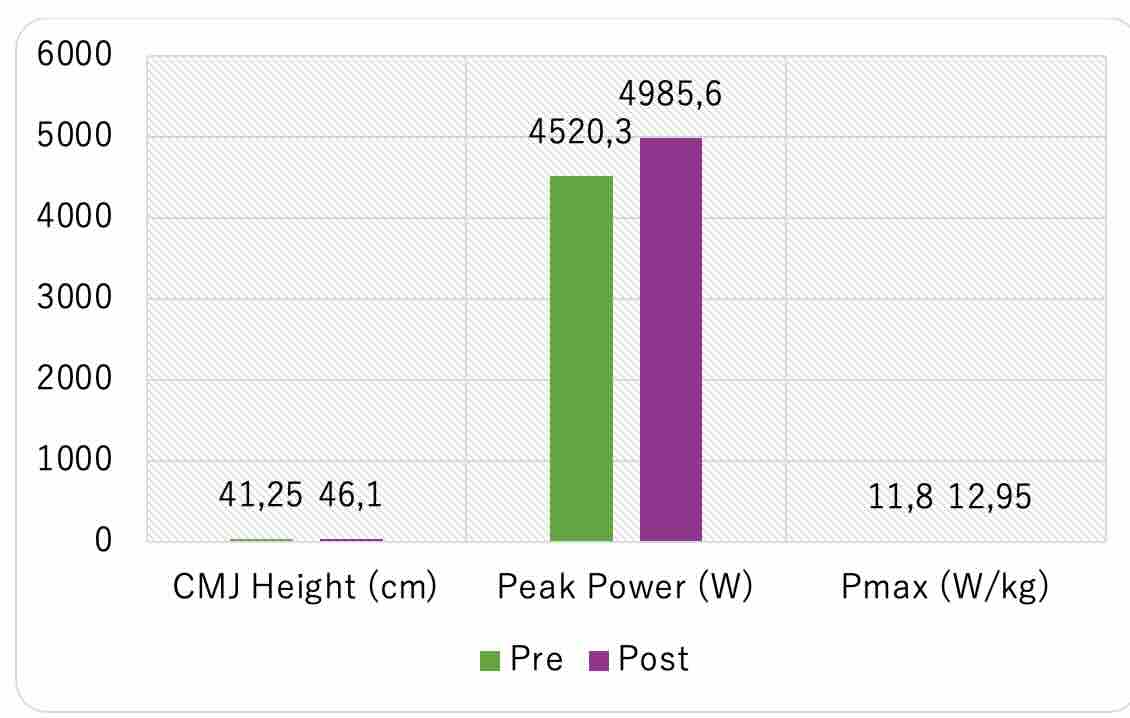
The purpose of this study was to determine the effect of resistance training periodization on power output and sprint performance in a cohort of track athletes. The researchers employed an experimental design—repeated measures. There were twenty male (100 m, 200 m, and 400 m) track athletes that took part in the study. The participants completed an 8-week periodized program utilising resistance training consisting of three sessions per week progressing from maximal strength development to strength–power conversion. Performance variables included countermovement jump (CMJ), peak power, 10 m and 30 m sprint time, and force–velocity profile indicators (F0, V0, and Pmax). Pre- and post-tests were conducted under controlled conditions. For statistical analyses, paired-samples t-tests were performed, and significance was set at p ≤ 0.05; effect sizes (Cohen’s d) were also calculated. Consequently, the authors found that all variables improved, with CMJ height and CMJ peak power increasing 11.76% and 10.29%, respectively, highlighting an improvement in lower-limb explosive power. Sprint performance was significantly improved (4.40% and 3.74% reductions in 10 m and 30 m sprint times, respectively). There were positive adaptations according to the force–velocity profile variables, with F0 (+7.48%), V0 (+3.91%), and Pmax (+9.75%) values all increasing. The authors reported that the effect sizes were mostly large. In conclusion, our findings indicated that periodized resistance training increased both power output and 10m sprint times in track athletes. Progressively transitioning from maximal strength to explosive power appears to be an effective approach to enhance neuromuscular adaptations and sprint-specific performance in this population. As such, periodized resistance training should be integrated within sprint training programs to optimize athletic performance.
References
Anicic, Z., García-Ramos, A., Mirkov, D., & Pérez-Castilla, A. (2023). Assessment of countermovement jump: What should we report? Sports Medicine, 53(2), 325–346. https://doi.org/10.1007/s40279-022-01825-5
Bolger, R., Lyons, M., Harrison, A. J., & Kenny, I. C. (2015). Sprinting performance and resistance-based training interventions: A systematic review. Journal of Strength and Conditioning Research. https://doi.org/10.1519/JSC.0000000000000720
Cormie, P., McGuigan, M. R., & Newton, R. U. (2011). Developing maximal neuromuscular power: Part 1—Biological basis of maximal power production. Sports Medicine, 41(1), 17–38. https://doi.org/10.2165/11537690-000000000-00000
Hartmann, H., Wirth, K., Keiner, M., Mickel, C., Sander, A., & Szilvas, E. (2015). Short-term periodization models: Effects on strength and speed-strength performance. Sports Medicine, 45(10), 1373–1386. https://doi.org/10.1007/s40279-015-0355-2
Hasegawa, T., Doma, K., Leicht, A. S., & Sinclair, W. H. (2024). Effects of high-intensity sprint exercise on neuromuscular fatigue and countermovement jump performance. Sports, 12(5), 132. https://doi.org/10.3390/sports12050132
Haugen, T., Tønnessen, E., & Seiler, S. (2019). The training and development of elite sprint performance. Sports Medicine, 49(11), 1643–1668. https://doi.org/10.1007/s40279-019-01147-1
Haugen, T., Tønnessen, E., & Seiler, S. (2019). The training and development of elite sprint performance: An integration of scientific and best practice literature. Sports Medicine, 49(11), 1643–1668. https://doi.org/10.1007/s40279-019-01147-1
Haugen, T., Tønnessen, E., & Seiler, S. (2019). The training and development of elite sprint performance. Sports Medicine, 49(11), 1801–1818. https://doi.org/10.1007/s40279-019-01143-5
Hicks, D. S., Drummond, C., Williams, K. J., & van den Tillaar, R. (2022). Exploratory analysis of sprint force-velocity characteristics across a periodized training year. International Journal of Environmental Research and Public Health, 19(22), 15404. https://doi.org/10.3390/ijerph192215404
Lindberg, K., Solberg, P. A., Bjørnsen, T., Helland, C., & Haugen, T. (2021). Force-velocity profiling in athletes: Reliability and agreement across methods. PLoS One, 16(2), e0245791. https://doi.org/10.1371/journal.pone.0245791
Lorenz, D., Reiman, M., & Walker, J. (2015). Periodization: Current review and suggested implementation. Sports Health, 7(6), 509–518. https://doi.org/10.1177/1941738115593790
Loturco, I., Pereira, L. A., Freitas, T. T., Bishop, C., Zanetti, V., & McGuigan, M. R. (2019). Predictive factors of elite sprint performance. Journal of Strength and Conditioning Research.
Loturco, I., Pereira, L. A., Kobal, R., & Nakamura, F. Y. (2015a). Relationship between sprint ability and jump performance. Journal of Strength and Conditioning Research.
Moir, G., Sanders, R., Button, C., & Glaister, M. (2007). The effect of periodized resistance training on accelerative sprint performance. Sports Biomechanics, 6(3), 285–300. https://doi.org/10.1080/14763140701489793
Morin, J. B., Edouard, P., & Samozino, P. (2011). Technical ability of force application as a determinant factor of sprint performance. Medicine & Science in Sports & Exercise, 43(9), 1680–1688. https://doi.org/10.1249/MSS.0b013e318216ea37
Morin, J. B., Samozino, P., Edouard, P., & Tomazin, K. (2012). Effect of force–velocity imbalance on sprint performance. International Journal of Sports Physiology and Performance, 7(4), 394–402.
Osses-Rivera, A., Yáñez-Sepúlveda, R., Jannas-Vela, S., Vigh-Larsen, J. F., & Monsalves-Álvarez, M. (2024). Effects of strength training on repeated sprint ability in team sports players: A systematic review. PeerJ, 12, e17756. https://doi.org/10.7717/peerj.17756
Petrigna, L., Thomas, E., Straub, A. M., Paulus, M., & Pajaujiene, S. (2019). A review of countermovement and squat jump testing methods in the context of physical fitness assessment. Sports, 7(7), 160. https://doi.org/10.3390/sports7070160
Samozino, P., Rabita, G., Dorel, S., Slawinski, J., Peyrot, N., & Saez-de-Villarreal, E. (2016). A simple method for measuring power, force, velocity properties of sprint running. International Journal of Sports Physiology and Performance, 11(2), 152–160.
Sanz-Matesanz, M., et al. (2025). Optimising sprint performance through combined resistance and plyometric training. Sports, 10(1), 51. https://doi.org/10.3390/sports10010051
Šarabon, N., Kozinc, Ž., & Markovic, G. (2021). Reliability of sprint force-velocity-power profiles obtained from high-level sprinters. Journal of Sports Science & Medicine, 20(2), 357–364. https://doi.org/10.52082/jssm.2021.357
Standing, R. J., Maulder, P. S., & Lees, A. (2017). The biomechanics of standing start and initial acceleration. Sports Medicine, 47(5), 833–845. https://doi.org/10.1007/s40279-016-0627-7
Stockdale, R. A., Black, C. J., Scott, B. R., & Lovell, R. (2025). Validity and reliability of sprint force-velocity profiling in elite football. Biology of Sport, 42(2), 405–415. https://doi.org/10.5114/biolsport.2025.139004
Stojanović, E., Ristić, V., McMaster, D. T., & Milanović, Z. (2017). Effect of plyometric training on vertical jump performance. Sports Medicine, 47(5), 975–986. https://doi.org/10.1007/s40279-016-0636-6
Suchomel, T. J., Nimphius, S., & Stone, M. H. (2016). The importance of muscular strength in athletic performance. Sports Medicine, 46(10), 1419–1449. https://doi.org/10.1007/s40279-016-0486-0
Van Hooren, B., & Bosch, F. (2024). Optimizing resistance training for sprint and endurance performance. Sports Medicine. https://doi.org/10.1007/s40279-024-02110-4