The Relationship Between Communication Skills and Cognitive Perception Among Students of The College of Physical Education and Sport Sciences From the Teachers' Perspective
DOI:
https://doi.org/10.66968/pejuang/v23119142Keywords:
Communication Skills, Non-verbal Communication, Cognitive Cognition, Attention and ConcentrationAbstract
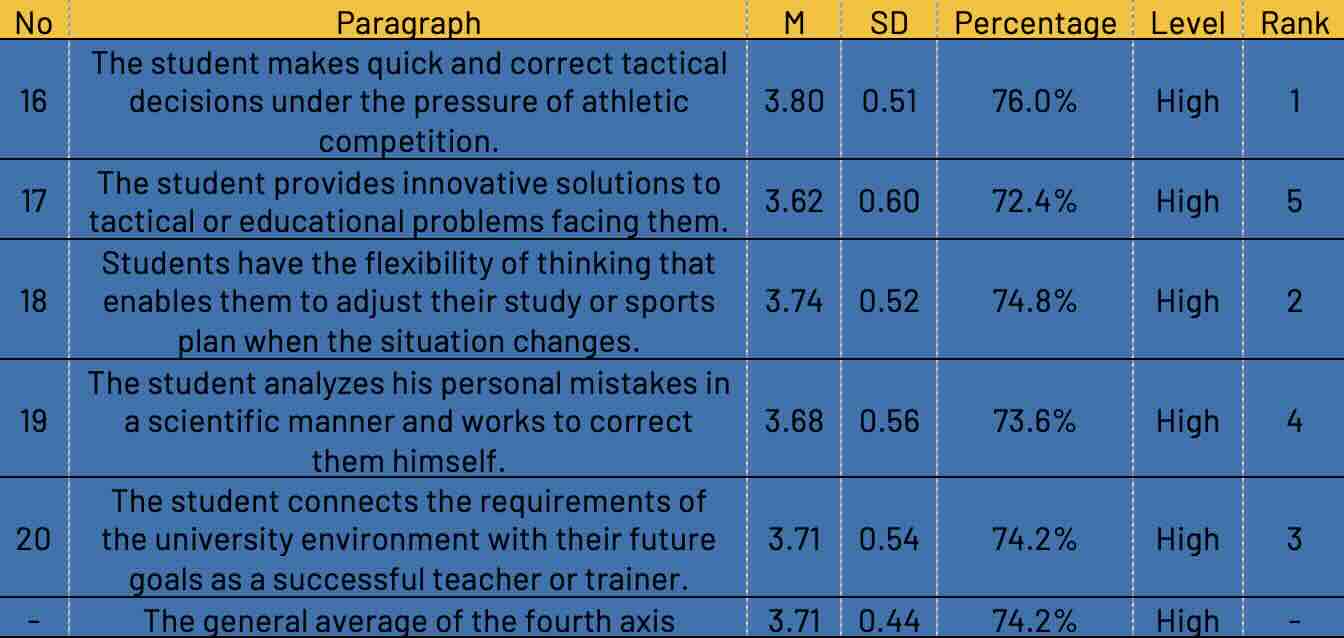
The present study aimed at identifying the level of communication skills and the level of cognitive perception among the students of the College of Physical Education and Sport Sciences at Misan University, and revealing the nature of the correlational relationship between their communication skills and cognitive cognition. The research was carried out with the descriptive approach and the relational method, in accordance with the nature of the research and its objectives. The research sample consisted of college students who were enrolled in the academic year and were selected by random method. To achieve the objectives of the research, the researcher used the Communication Skills Scale (verbal, non-verbal, and listening), and the Listening Scale Cognitive cognition (attention and cognitive concentration, mental processing, recall and tactical thinking), and after confirming the scientific conditions of the two scales of truthfulness and consistency, the data were statistically treated using the statistical package (SPSS 25). The results were: Overall, students have (high) level of communication skills with the first place of the “non-verbal communication” axis. Students have a high level of cognitive cognition, with the "Attention and Cognitive Focus" axis leading the other axes, filtering distractions, and responding to direct observation methods and immediate feedback from the teaching staff. There is a positive and statistically significant relationship between communication skills and cognitive cognition. Effective communication (verbal, non-verbal and listening) is the main input for encoding motor and tactical information and storing it in long-term memory. The results led the researcher to recommend that teachers and trainers should focus on promoting and developing non-verbal communication codes and unified tactical signals during educational and training units. Including exercises to increase capacity for attention control and cognitive selection among distractions of the field.
References
Adriani, V., & Irwandy, D. (2024). Interpersonal Communication Using Personal Sport Device In Forming Community. Journal of Communication and Public Relations, 3(1), 1-18.
Akpetou, J., & Furley, P. (2023). Communication in sports teams. Group Communication, 324-339.
Alibogloo, H. P. (2026). The Integration of Cognitive Neuroscience Principles in Communication Education: A Comprehensive Review of Curricular Designs and Skill Transfer Efficacy. OBM Neurobiology, 10(2), 1-17.
Arban, J., Domdom, V., Aliazas, J. V., & Gimpaya, R. (2023). Competency assessment of physical education teachers and its influence on students’ cognitive learning. International Journal of Scientific and Management Research, 6(6), 28-44.
Barzyk, P. (2024). Motor Learning in Sports and Rehabilitation: From classical strategies towards innovative technologies (Doctoral dissertation, Universität Konstanz).
Farrow, D., Baker, J., & MacMahon, C. (Eds.). (2023). Developing sport expertise: Researchers and coaches put theory into practice. Taylor & Francis.
García-Fariña, A. (2025). Perspective chapter: the role of instructional communication in enhancing active learning–new approaches for the physical education of the future. In Teacher Training and Student Learning-Past Values, Present Uncertainties and Future Prospects. IntechOpen.
Hesar, R., & Rahmadini, R. (2025). The Role Of Group Communication In Collaborative Learning In Physical Education. MEDIOVA: Journal of Islamic Media Studies, 5(1), 100-117.
Li, X. (2024). Enhancing university physical education through data-driven reform of sports club systems. Journal of Combinatorial Mathematics and Combinatorial Computing, 119, 13-22.
Lochhead, L., Feng, J., Laby, D. M., & Appelbaum, L. G. (2024). Training vision in athletes to improve sports performance: a systematic review of the literature. International Review of Sport and Exercise Psychology, 1-23.
Lu, H. F. (2023). Statistical learning in sports education: A case study on improving quantitative analysis skills through project-based learning. Journal of Hospitality, Leisure, Sport & Tourism Education, 32, 100417.
Molina-García, N., González-Serrano, M. H., Ordiñana-Bellver, D., & Baena-Morales, S. (2024). Redefining education in sports sciences: A theoretical study for integrating competency-based learning for sustainable employment in Spain. Social Sciences, 13(5), 242.
Nikolic, J. L. (2025). The Coach's Soft Power: Communication Skills as a Key to Developing Sports Teams and Athletes. AGORA Int'l J. Jurid. Sci., 19, 192.
Pal, A., Kumari, P., & Yadav, P. (2025). Play, Lead, Teach: Tapping Into the Power of Sports for Teacher Development and Classroom Innovation. In Holistic Approaches to Teacher Development: Leadership, Pedagogical Practices, and Cognitive Insights (pp. 147-170). IGI Global Scientific Publishing.
Pastae, O. M. (2025). Silent Signals: The Role of Nonverbal Communication in Team Sports. Annals Constantin Brancusi U. Targu Jiu, Letters & Soc. Sci. Series, 47.
Ramos, J. R., Guillén, M. J. G., Paredes, A. C., & Arroyo, M. D. C. G. (2025). Impact of verbal and non-verbal communication in educational settings on perception of importance of physical education in adolescence. Retos: nuevas tendencias en educación física, deporte y recreación, (62), 1042-1049.
Schmidt, R. A., & Lee, T. D. (2025). Motor learning and performance: From principles to application. Human Kinetics.
Shi, Y., Wang, Z., & Lipowski, M. (2024). Integrating school physical education into adolescent resilience education in the context of integration of sports and education in the new era: A literature review study. US-China Education Review, 14(8), 505-19.
Siedentop, D., & Van der Mars, H. (2022). Introduction to physical education, fitness, and sport. Human kinetics.
Tokay, B., & Akil, M. (2025). Tactical-game and technical approach: the importance of sport type and method in developing metacognitive control and awareness in school going children. Current Psychology, 44(12), 11460-11471.
Yang, X., Tian, J., & Madni, G. R. (2025). A nexus among sports education, psychological well-being, social development, strategic capacity, and environmental awareness in China. BMC Sports Science, Medicine and Rehabilitation, 17(1), 287.
Zou, L., Zhang, Z., Mavilidi, M., Chen, Y., Herold, F., Ouwehand, K., & Paas, F. (2025). The synergy of embodied cognition and cognitive load theory for optimized learning. Nature Human Behaviour, 9(5), 877-885.
Downloads
Published
Issue
Section
License
Copyright (c) 2026 Hassanein Sharif AbdelWahab, Munadhil Adil Kasim (Author)

This work is licensed under a Creative Commons Attribution-ShareAlike 4.0 International License.